“Consumers are adapting their attitudes about food to a changing climate and aiming for more sustainable eating habits, research in Tetra Pak’s 2023 Index suggests.” The research also indicates that consumers are gravitating towards healthier products, a trend that is hampered little by economic concerns.
“According to Tetra Pak’s Index 2023, based on research conducted by market research firm IPSOS, which surveyed consumers in ten countries (Brazil, China, Germany, India, Kenya, South Africa, South Korea, Spain, the UK, and the USA), consumers are adapting the way they eat in order to be more sustainable. Tetra Pack calls these consumers ‘climatarians.’” (Bambridge-Sutton, 2023)
“Seventy percent of these consumers stated their beliefs that healthy products shouldn’t harm the environment, while 54% said they are willing to take responsibility for helping the planet through their own diet. As well as overall sustainability, consumers are also concerned about more specific issues. For example, 38% of respondents said that food waste was a major concern.” (Bambridge-Sutton, 2023)
What is a ‘Climatarian’ and a ‘Climatarian Diet’?
Kearney, the global management firm, defines ‘climavorism’ as: “actively making food choices based on climate impacts with the intent to benefit the planet.” (Kearney, 2023) Scientists are studying the environmental impacts of a ‘climatarian diet’ as well.
At UCLA, researchers analyzed six dietary patterns: standard American, Mediterranean, vegan, paleo, and keto, as well as a “climatarian” diet — which the researchers defined as a diet that minimizes the consumption of red meats and other foods, such as out-of-season produce, that have large carbon footprints. (Dixon et al., 2023)
These researchers noted that “Carbon dioxide emissions associated with food come mainly from production, transportation and disposal in landfills, rather than from the food itself.” (Dixon et al., 2023)
“The study’s authors quantified the carbon emissions associated with each of the six diets by using previously published research and a database that tracks foods by their carbon emissions. They analyzed the food consumed in a typical day following each diet, limiting the study to foods that are available in North America, and then standardized the data to 2,000 calories per day.” (Dixon et al., 2023)
“While the differences in carbon emissions created by the various diets are relatively small on a per-person per-day basis, they do add up. A climatarian diet with meat would release up to about 4,500 fewer pounds of carbon dioxide per year than a standard American diet — the equivalent of driving a car 5,060 miles.” (Dixon et al., 2023)
“According to some estimates, more than 80% of the U.S. population consumes the standard American diet. If all of those people converted to a climate-friendly diet, the carbon emissions savings would be roughly equivalent to driving 1.34 trillion fewer miles.” (UCLA, Institute of the Environment & Sustainability, 2023)
“Not only do Mediterranean, vegan and climatarian diets support human health, according to previous research cited by the authors, but they also create smaller carbon footprints because they rely less on red meat and processed foods, said Catherine Carpenter, a UCLA adjunct professor of nutrition and the study’s senior author. Red meat has an especially large carbon footprint because raising animals for meat requires a large amount of land and water, and because livestock flatulence releases methane, a potent greenhouse gas…” (UCLA, Institute of the Environment & Sustainability, 2023)
“You can decrease your individual carbon footprint quite significantly and still consume meat, but it is highly dependent on the type of meat that you’re consuming,” said Malia Michelsen, a third-year undergraduate student at UCLA and co-author of the paper. (Dixon et al., 2023)
For example, a new study published in Nature Food that used dietary intake data from a nationally representative sample of 7,753 US adults and children reported that making simple dietary substitutions such as switching from beef to chicken or turkey or drinking plant-based milk instead of cow’s milk could reduce the average American’s carbon footprint from food by 35%, while also boosting diet quality by between 4-10%, according to the study authors. (Grummon et al., 2023)
“While people can reduce their climate footprint through the diets they choose, Michelsen said, those choices are often limited by financial considerations — climate-friendly food is usually more expensive — and by the availability of certain foods in certain neighborhoods and regions of the country. “
Michelsen said governments could help address the problem by subsidizing healthy food, corporations and other organizations that serve large numbers of constituents could make healthier food more accessible and less expensive, and producers [and food companies] could increase improve labeling to better inform consumers about their food’s climate impact.” (UCLA, Institute of the Environment & Sustainability, 2023; Dixon et al., 2023).
What does food have to do with climate change?
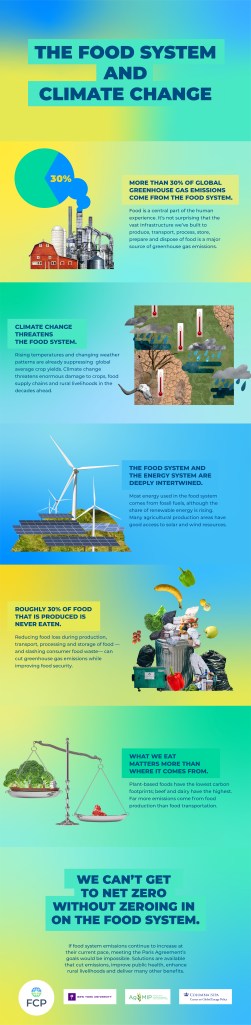
“What we eat, and how that food is produced, affects our health but also the environment. Food needs to be grown and processed, transported, distributed, prepared, consumed, and sometimes disposed of. Each of these steps creates greenhouse gases that trap the sun’s heat and contribute to climate change. About a third of all human-caused greenhouse gas emissions is linked to food.”


“The largest chunk of food-related greenhouse gases comes from agriculture and land use. This includes, for instance:
- methane from cattle’s digestive process,
- nitrous oxide from fertilizers used for crop production,
- carbon dioxide from cutting down forests for the expansion of farmland,
- other agricultural emissions from manure management, rice cultivation, burning of crop residues, and the use of fuel on farms.”
Which foods cause the most greenhouse gas emissions?
The climate impact of food is measured in terms of greenhouse gas emissions intensity.
“The emissions intensity is expressed in kilograms of “carbon dioxide equivalents” – which includes not only CO2 but all greenhouse gases – per kilogram of food, per gram of protein or per calorie.”
“Animal-based foods, especially red meat, dairy, and farmed shrimp, are generally associated with the highest greenhouse gas emissions. This is because:
- Meat production often requires extensive grasslands, which is often created by cutting down trees, releasing carbon dioxide stored in forests.
- Cows and sheep emit methane as they digest grass and plants.
- The cattle’s waste on pastures and chemical fertilizers used on crops for cattle feed emit nitrous oxide, another powerful greenhouse gas.
- Shrimp farms often occupy coastal lands formerly covered in mangrove forests which absorb huge amounts of carbon. The large carbon footprint of shrimp or prawns is mainly due to the stored carbon that is released into the atmosphere when mangroves are cut down to create shrimp farms.”
“Plant-based foods – such as fruits and vegetables, whole grains, beans, peas, nuts, and lentils – generally use less energy, land, and water, and have lower greenhouse gas intensities than animal-based foods.”
“Emissions can be compared based on weight (per kilogram of food), or in terms of nutritional units (per 100 grams of protein or per 1000 kilocalories) which shows us how efficiently different foods supply protein or energy. See the resource (link) below for three charts showing the carbon footprint of different food products.” (UN, Food and Climate Change: Healthy Diets for a healthier planet)
UN: Food and Climate Change: Healthy diets for a healthier planet
https://www.un.org/en/climatechange/science/climate-issues/food
What can you do now to address climate change as it relates to food?
Number 1: Eat healthier meals – Start eating a more plant-rich, balanced diet – one that provides energy and nutrients from several different food groups – and reduce foods that are harder on our planet. Meat and dairy can be important sources of protein and micronutrients, particularly in lower-income countries where diets lack diversity. But in most high-income countries, shifting to more plant-based foods promotes better health and significantly lowers your environmental impact compared to the average meat-based diet.
Source: United Nations (UN). Food and Climate Change: Healthier diets for a healthier planet. Available at: https://www.un.org/en/climatechange/science/climate-issues/food
Number 2: Try a sustainable recipe – Try one or more sustainable recipes by leading chefs around the globe who are cooking up dishes that are not only delicious but also good for you and the planet.
Access the ActNow Food Challenge Sustainable Recipes at:
https://www.un.org/sustainabledevelopment/actnow-food-challenge/
Source: United Nations (UN). Food and Climate Change: Healthier diets for a healthier planet. Available at: https://www.un.org/en/climatechange/science/climate-issues/food
Number 3: Cut your food waste – Think about how you buy, prepare and dispose of food. When you throw away food, you’re also wasting the energy, land, water, and fertilizer that was used to produce, package, and transport it.
Only buy what you need – and use up what you buy. And don’t shy away from buying imperfect-looking fruits and vegetables. They might otherwise get thrown out.
Stop the waste, save money, reduce emissions, and help preserve resources for future generations.
If you do need to throw out food, composting your leftovers can reduce the amount of methane and CO2 released by the organic waste.
Source: United Nations (UN). Food and Climate Change: Healthier diets for a healthier planet. Available at: https://www.un.org/en/climatechange/science/climate-issues/food
Number 4: Start composting – Composting can be a simple yet impactful action to help reduce emissions from our food system. When we throw our food waste in the garbage, the food waste will typically travel more miles because landfills are further away from our neighborhoods, resulting in higher transport emissions. Additionally, food waste in landfills are buried in conditions with no oxygen. When food decomposes in these conditions, methane, a greenhouse gas that is more potent than carbon dioxide, is produced as a byproduct.
Composting on the other hand often results in fewer transport emissions because compost stations are closer to our neighborhoods. Additionally, the process of composting involves turning the soil and food waste which ensures that oxygen is present in the process of decomposition. As a result, carbon dioxide is produced instead of methane which is better for the planet. Lastly, compost becomes nutrition-dense soil that can then be used for farming or planting which adds back precious nutrients into the soil and resulting food.
Where is the nearest compost station? Does your city or district offer compost pick-up? Does your workplace or favorite restaurants compost?
Source: United Nations (UN). Your Guide to Climate Action: Food. Available at: https://www.un.org/en/actnow/food
Number 5: Shop local and organic – Food miles (how far our food travels) and fertilizer use are important topics to consider when it comes to the impact of our food system on the planet. When it comes to food miles, the longer the distance our food travels from the farm to the place where we purchase food, the higher the greenhouse gas emissions from transport vehicles. Shopping and eating local can help reduce the food miles travelled and can help an individual save up to 1.1 tons of carbon emissions annually. Eating what’s in season can also help reduce food miles because out of season foods are often transported from farms that are further away or in a different country altogether, resulting in additional food miles to get to our stores.
Eating organic also reduces the need for fertilizers which often result in nitrous oxide emissions, a highly potent greenhouse gas that is more detrimental than carbon dioxide and methane. Organic farming often includes regenerative agriculture techniques which not only reduce emissions but also improve soil health and increase the amount of nutrients in our food, among many other benefits. Eating organic can reduce our individual carbon footprint by up to 0.9 tons annually!
What foods are currently in season where you live? Do you have access to a shop or farmers market with food from local growers? Does your local grocery store sell organic produce?
Source: United Nations (UN). Your Guide to Climate Action: Food. Available at: https://www.un.org/en/actnow/food
Number 6: Shop with a reusable bag – The production, use and disposal of plastics contribute to climate change. Instead of a plastic bag, use your own reusable bag and reduce the amount of plastic waste in our world.
Source: United Nations (UN). Food and Climate Change: Healthier diets for a healthier planet. Available at: https://www.un.org/en/climatechange/science/climate-issues/food
Number 7: Download AWORLD, the official platform for ActNow – https://actnow.aworld.org/
Source: United Nations (UN). Food and Climate Change: Healthier diets for a healthier planet. Available at: https://www.un.org/en/climatechange/science/climate-issues/food
Number 8: Take the “Global Climate Pledge” – To learn more, go to:
Global Climate Pledge
https://www.globalclimatepledge.com/individual-pledge/#:~:text=The%20Global%20Climate%20Pledge,Together%2C%20we%20will%20succeed
References
Bambridge-Sutton A. More than half of consumers are ‘climatarians’ and show concern for environment, Tetra Pak Index suggests. Food Navigator. October 27, 2023. Available at: https://www.foodnavigator.com/Article/2023/10/27/more-than-half-of-consumers-are-climatarians-and-show-concern-for-environment-tetra-pak-index-suggests
Kearney. Four scenarios for rapid adoption of climavorism: New research. Kearney Global Management Consulting. April 21, 2023. Available at: https://www.kearney.com/consumer-retail/article/-/insights/four-scenarios-for-rapid-adoption-of-climavorism
Bauck W. Eat plants and go electric: how to break food TV’s bad climate habits. The Guardian. October 27, 2023. Available at: https://www.theguardian.com/environment/2023/oct/27/tv-cooking-shows-climate-change-sustainability
UCLA, Institute of the Environment & Sustainability. Vegan, Mediterranean, and ‘climatarian’ diets have lower carbon footprints than standard US diet. March 20, 2023. Available at: https://newsroom.ucla.edu/releases/paleo-keto-climatarian-diet-carbon-footprint
Dixon, K.A.; Michelsen, M.K.; Carpenter, C.L. Modern Diets and the Health of Our Planet: An Investigation into the Environmental Impacts of Food Choices. Nutrients 2023, 15, 692. https://doi.org/10.3390/nu15030692
Grummon, A.H., Lee, C.J.Y., Robinson, T.N. et al. Simple dietary substitutions can reduce carbon footprints and improve dietary quality across diverse segments of the US population. Nature Food; 2023. https://doi.org/10.1038/s43016-023-00864-0
Tulane University. Press Release. Study shows simple diet swaps can cut carbon emissions and improve your health. October 26, 2023. Available at: https://www.eurekalert.org/news-releases/1005580#:~:text=According%20to%20a%20new%20study,by%2035%25%2C%20while%20also%20boosting
United Nations (UN). Food and Climate Change: Healthier diets for a healthier planet. Available at: https://www.un.org/en/climatechange/science/climate-issues/food
United Nations (UN). Your Guide to Climate Action: Food. Available at: https://www.un.org/en/actnow/food
Food and Climate InfoGuide, Colombia University, Center on Global Energy Policy. 2021. Available at: https://www.energypolicy.columbia.edu/publications/food-and-climate-change-infoguide/
 Sustainable RDN