Two new studies published in peer-reviewed journals in mice suggest that high-fiber diets, such as diets that are high in legumes and fruits and vegetables, may help nanoplastics pass through the gut without being absorbed. High-fat diets, by contrast, appear to make the body hold onto more of them. Nanoplastics are the tiny plastic particles that are strewn through oceans and soils and are found in the food we eat. (Fox, 2026; Rosen, 2026; Yu et al., 2026; Ji et al., 2026)
What is the Difference between Microplastics and Nanoplastics?
“Microplastics are particles between 1 µm and 5 mm. Nanoplastics are particles below 1 µm (1,000 nm), and many working groups use 100 nm as a stricter cutoff to match the broader nanomaterial science definition. For scale: a human hair is ~70,000 nm wide, a red blood cell is ~7,000 nm, a typical bacterium is ~1,000 nm, a SARS-CoV-2 virion is ~100 nm.” (MicroPlastics Research Desk, 2026)
“Nanoplastics overlap virus-sized range and can cross biological barriers, cell membranes, the placenta, the blood-brain barrier, that microplastics cannot. That is why nano is the part of the size distribution toxicologists are most concerned about, even though micro is what we can currently measure most reliably.” (MicroPlastics Research Desk, 2026).
Why is Plastic Pollution a Problem?
“Millions of tons of plastic waste enter the environment each year. This waste slowly degrades into microplastics and nanoplastics that find their way into farms, plants, ocean life, and even the Amazon—where they were recently found in the blood of wild tapirs and anteaters.”
“Once ingested with food, these tiny particles percolate into the human brain, lungs, liver, kidneys, placenta, and testes, where they cause inflammation, oxidative stress, DNA damage, and other cellular injuries. Nanoplastics are even found in the atherosclerotic plaques of our coronary arteries, where they increase the risk of heart attack, stroke, or premature death by more than 4-fold.” (Fox, 2026)
“The two new studies looked at how diet influences the absorption and effects of nanoplastics in mice. One study found that in the first 24 hours after consuming nanoplastics, mice eating medium- or high-fiber diets accumulated two to seven times less plastics in their intestinal tract than those on regular diets.” (Fox, 2026; Yu et al., 2026, Ji et al., 2026). Mice fed nanoplastics for 28 days experienced inflammation and breakdown of their intestinal barriers—setting the stage for nanoplastics to enter the rest of the body; but these negative effects were sharply reduced in mice on medium- and high-fiber diets.” (Yu et al., 2026)
“The second study also found that high dietary fiber reduced nanoplastic absorption—while high-fat diets actually increased the absorption of nanoplastics by 2.8-fold compared to regular diets. That finding is especially worrisome, given that fast foods and takeout foods, both rich in fat, are often served in containers laced with plastics.” (Fox, 2026; Ji et al, 2026).
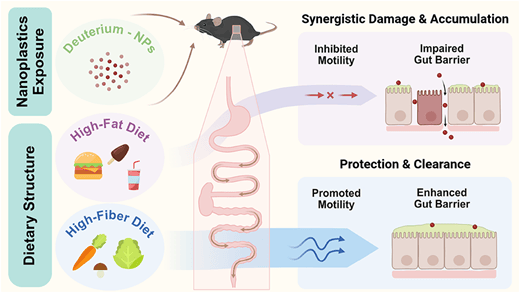
Image source: Ji Z, He E, Guo Z, et al. Dietary fat and fiber divergently control intestinal nanoplastic bioaccumulation through gut motility and barrier pathways. Environmental Science & Technology. 2026; 60(27):19121–19133. https://doi.org/10.1021/acs.est.6c01747
“In the two new studies, dietary fiber may have exerted its protective effects by shaping the intestinal microbiome, coating the nanoplastic particles, and speeding up their elimination through [feces], allowing the intestinal lining to avoid excessive exposure.” (Fox, 2026; Yu et al., 2026; Ji et al., 2026).
“These new insights come at a time when scientists are already proposing higher-plant and lower-animal diets that could improve worldwide health while also reducing the environmental impacts of the global food system, such as greenhouse emissions, water pollution, and land use. Human studies are needed to confirm these newest results.” However, for now, these preliminary results suggest that following sustainable diets high in dietary fiber (e.g., legumes, fruits and vegetables) could help individuals reduce their body burden of nanoplastics. (Fox, 2026)
References
Fox D. Nanoplastics and climate change have an unexpected enemy: fiber. Anthropocene Magazine. November 13, 2026. Available at: https://na01.safelinks.protection.outlook.com/?url=https%3A%2F%2Fwww.anthropocenemagazine.org%2F2026%2F11%2Fnanoplastics-and-climate-change-have-an-unexpected-enemy-fiber%2F&data=05%7C02%7C%7Cf082179f0cbf486c752108df43f2be2d%7C84df9e7fe9f640afb435aaaaaaaaaaaa%7C1%7C0%7C639304381976340525%7CUnknown%7CTWFpbGZsb3d8eyJFbXB0eU1hcGkiOnRydWUsIlYiOiIwLjAuMDAwMCIsIlAiOiJXaW4zMiIsIkFOIjoiTWFpbCIsIldUIjoyfQ%3D%3D%7C0%7C%7C%7C&sdata=sxgZriEW%2BKLqr71RcKUhj%2F6ssiUoX9eusvvHFnH1Wwk%3D&reserved=0
Nanoplastics Size vs Microplastics: How Small Is Nano, Really? MicroPlastics Research Desk. June 5, 2026. Available at: https://microplasticsapp.com/blog/nanoplastics-size-vs-microplastics
Yu, Z., Abulipizi, G., Fang, Y. et al. High fiber diet mitigates exposure risk of nanoplastics in male mice. Nature Communications. 2026;17:11630. https://doi.org/10.1038/s41467-026-78675-7 https://www.nature.com/articles/s41467-026-78675-7
Rosen M. A high-fiber diet may clear away plastic in the gut. Science News. November 9, 2026. Available at: https://na01.safelinks.protection.outlook.com/?url=https%3A%2F%2Fwww.sciencenews.org%2Farticle%2Fhigh-fiber-diet-nanoplastic-gut-health&data=05%7C02%7C%7Cc82dc4c844a440617bf908df44c0a76b%7C84df9e7fe9f640afb435aaaaaaaaaaaa%7C1%7C0%7C639305266358306128%7CUnknown%7CTWFpbGZsb3d8eyJFbXB0eU1hcGkiOnRydWUsIlYiOiIwLjAuMDAwMCIsIlAiOiJXaW4zMiIsIkFOIjoiTWFpbCIsIldUIjoyfQ%3D%3D%7C0%7C%7C%7C&sdata=5SoByI0coG%2FN7yjzZHS8L8E5Pvazb30DQPSwThN9Dhc%3D&reserved=0
Ji Z, He E, Guo Z, et al. Dietary fat and fiber divergently control intestinal nanoplastic bioaccumulation through gut motility and barrier pathways. Environmental Science & Technology. 2026; 60(27):19121–19133. https://doi.org/10.1021/acs.est.6c01747
International Pollutants Elimination Network (IPEN). Indisputable Evidence Shows the Peril from Endocrine Disrupting Chemicals, Yet Policies to Protect Human Health Lag Decades Behind the Science. Press Release. United Nations Environment Programme (UNEP). November 17, 2026. Available at: https://ipen.org/indisputable-evidence-shows-the-peril-from-endocrine-disrupting-chemicals-yet-policies-to-protect-human-health-lag-decades-behind-the-science/

