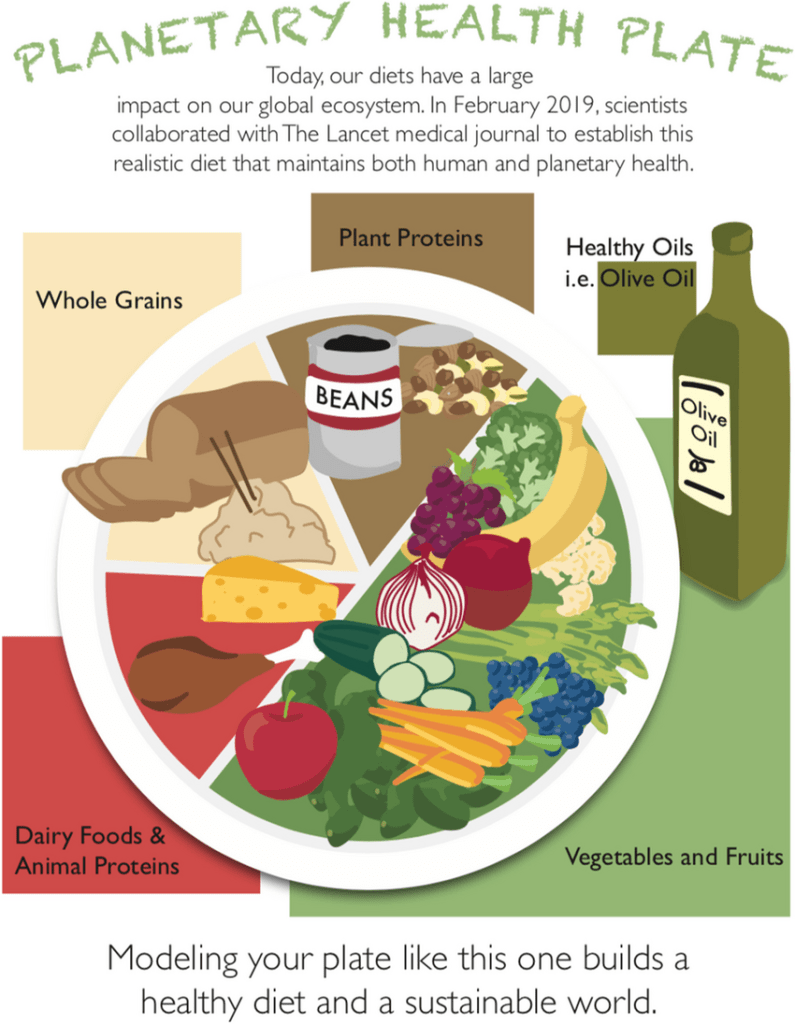
Persons who “eat a healthy, sustainable diet may substantially lower their risk of premature death in addition to their environmental impact, according to a new study led by Harvard T.H. Chan School of Public Health. It is the first large study to directly evaluate the impacts of adherence to recommendations in the landmark 2019 EAT-Lancet report.” The researchers named the dietary pattern outlined in the report—which emphasizes a variety of minimally processed plant foods but allows for modest consumption of meat and dairy foods—the [EAT-Lancet] Planetary Health Diet (PHD). (Bui et al., 2024; Harvard T.H. Chan School of Public Health, 2024)
The study was published online June 10 in The American Journal of Clinical Nutrition.
“Climate change has our planet on track for ecological disaster, and our food system plays a major role,” said corresponding author Walter Willett, professor of epidemiology and nutrition. “Shifting how we eat can help slow the process of climate change. And what’s healthiest for the planet is also healthiest for humans.”
“While other studies have found that diets emphasizing plant-based foods over animal-sourced foods could have benefits for human and planetary health, most have used one-time dietary assessments, which produce weaker results than looking at diets over a long period of time.” (Harvard T.H. Chan School of Public Health, 2024)
The researchers used health data from more than 200,000 women and men enrolled in the Nurses’ Health Study I and II and the Health Professionals Follow-Up Study. Participants were free of major chronic diseases at the start of the study and completed dietary questionnaires every four years for up to 34 years. Participants’ diets were scored based on intake of 15 food groups—including whole grains, vegetables, poultry, and nuts—to quantify adherence to the PHD. (Bui et al., 2024; Harvard T.H. Chan School of Public Health, 2024)

The study found that the risk of premature death was 30% lower in the top 10% of participants most closely adhering to PHD compared to those in the lowest 10%. Every major cause of death, including cancer, heart disease, and lung disease, was lower with greater adherence to this dietary pattern. (Bui et al., 2024; Harvard T.H. Chan School of Public Health, 2024)
In addition, the researchers found that those with the highest adherence to the PHD had a substantially lower environmental impact than those with the lowest adherence, including 29% lower greenhouse gas emissions, 21% lower fertilizer needs, and 51% lower cropland use.
The researchers noted that land use reduction is particularly important as a facilitator of re-forestation, which is seen as an effective way to further reduce levels of greenhouse gases that are driving climate change. (Bui et al., 2024; Harvard T.H. Chan School of Public Health, 2024)
Debate and Criticism
According to Lin et al. (2024), “the EAT-Lancet [planetary health] diet has sparked significant debate and criticism. Critics argue that its one-size-fits-all approach overlooks cultural and individual dietary needs, potentially leading to nutritional deficiencies in populations accustomed to different eating habits.” (Lin et al., 2024)
Beal et al. (2023) evaluated the estimated micronutrient shortfalls of the EAT–Lancet planetary health diet, and these authors reported that the EAT–Lancet diet might not provide adequate nutrients, especially in micronutrients like iron, calcium, and zinc, potentially leading to some public health issues. This diet, focusing on minimally processed plant foods and low in animal sources, may require adjustments, such as increasing nutrient-dense foods like fish, shellfish, seeds, eggs, and beef, and decreasing foods high in phytate. (Lin et al., 2024; Beal et al., 2023)
Springmann countered this assessment by Beal et al. (2023) where he stated in The Lancet Planetary Health that:
A comprehensive diet and food-system analysis could have easily identified nutrient-dense foods for population groups with special nutrient needs that are healthier, more environmentally sustainable, and affordable than what Beal and colleagues proposed. It is now well recognized that even completely plant-based diets can be nutritionally adequate for all life stages.
The planetary health diet can include low to moderate amounts of animal source foods, which makes adjusting for special needs easy and straightforward. For example, increasing the relative amounts of dark green leafy vegetables or focusing on shellfish for fish intake would increase both iron and calcium, and small amounts of nutritional yeast or algae would increase B vitamins.
Thus, eating a nutritionally adequate diet is possible without wrecking long-term health, the planet, or the pocket. The challenge is to ensure that nutritionally important foods are available in local markets, especially for those vulnerable populations most in need. (Springmann, 2023)
In response, Beal and Ortenzi (2023) stated: “We hope future efforts to design a planetary health diet address the limitations of the EAT-Lancet’s adequacy assessment… Two flaws are particularly important, first the report does not mention the assumed iron bioavailability used, which could range from 5 – 18% depending on the type of diet. The report should indicate what type of bioavailability was used. The more plant-based a diet the lower the iron bioavailability. Second, zinc was assumed to have moderate bioavailability. The high amount of phytate in the EAT-Lancet diet (> 2400 mg) indicates zinc has low bioavailability (defined by an unrefined diet containing > 1200 mg of phytate).” (Beal and Ortenzi, 2023)
For more information on phytates in diets, see:
Rethinking Phytates: The Misunderstood Compounds in Plant Foods (March 7, 2024)
and
Phytase-rich school meals for enhanced micronutrient bioavailability (p. 83), In:
White Paper: School Meals and Food Systems: Rethinking the consequences for climate, environment, biodiversity, and food sovereignty (December 2023)
In summary, Lin et al., 2024 concluded that “Achieving dietary nutrient adequacy sustainably for the global population involves complex trade-offs between environmental preservation, reducing non-communicable diseases (NCDs), and nutrient adequacy.”

Affordability of the EAT-Lancet Planetary Health Diet
Springmann et al. reported in a study published in The Lancet Planetary Health (2021) that,
“Compared with the cost of current diets, the healthy and sustainable dietary patterns were, depending on the pattern, up to 22–34% lower in cost in upper-middle-income to high-income countries on average (when considering statistical means), but at least 18–29% more expensive in lower-middle-income to low-income countries. Reductions in food waste, a favorable socioeconomic development scenario, and a fuller cost accounting that included the diet-related costs of climate change and health care in the cost of diets increased the affordability of the dietary patterns in our future projections. When these measures were combined, the healthy and sustainable dietary patterns were up to 25–29% lower in cost in low-income to lower-middle-income countries, and up to 37% lower in cost on average, for the year 2050. Variants of vegetarian and vegan dietary patterns were generally most affordable, and pescatarian diets were least affordable…” (Springmann et al., 2021)
“In high-income and upper-middle-income countries, dietary change interventions that incentivize adoption of healthy and sustainable diets can help consumers in those countries reduce costs while, at the same time, contribute to fulfilling national climate change commitments and reduce public health spending. In low-income and lower-middle-income countries, healthy and sustainable diets are substantially less costly than western diets and can also be cost-competitive in the medium-to-long term, subject to beneficial socioeconomic development and reductions in food waste. A fuller accounting of the costs of diets would make healthy and sustainable diets the least costly option in most countries in the future.” (Springmann et al., 2021)
Study Shows Cost of EAT-Lancet Planetary Health Diet in India
In a study published in Global Food Security (2021), Tata-Cornell Institute (TCI) researchers demonstrated that while Indians eat a diet that costs roughly $1 per day, the EAT-Lancet planetary health diet costs $3-$5 per person per day. To satisfy the EAT-Lancet recommendations, an individual would have to spend $1 more each day on each of three food groups: meat, fish, and poultry; dairy products; and fruit. (Gupta et al., 2021; Tata-Cornell Institute, 2021).
The researchers find that seasonality contributes to price volatility for fruit, green leafy vegetables, and other vegetables. This drives the cost of the EAT-Lancet planetary health diet as high as $6 per day at certain times of the year, though the cost is generally lower.
The EAT-Lancet planetary health diet purports to represent the least-expensive healthy nutritional regime possible in sustainable food systems. The diet is rich in micronutrient-rich foods like fruits, vegetables, whole grains, legumes, nuts, and unsaturated oils. It includes moderate levels of seafood and poultry and very little red meat, refined grains, and added sugars. To meet the EAT-Lancet Commission’s goal of feeding 10 billion people sustainable, healthy diets by 2050, consumption of all food groups except starchy vegetables will need to be increased in South Asia.
TCI researchers recommend crop diversification and investments in rural infrastructure and well-functioning markets as measures needed to make the EAT-Lancet planetary health diet more affordable in India. (Gupta et al., 2021; TCI, 2021).
EAT-Lancet Planetary Health Diet May Increase the Economic and Physical Feasibility of 1.5° C
In a more recent study published in the journal Science Advances (2024), researchers found that, “a more sustainable, flexitarian diet increases the feasibility of the Paris Agreement climate goals in different ways,” says Florian Humpenöder, [Potsdam Institute For Climate Impact Research (PIK)] scientist and co-lead author of the study published in Science Advances. (PIK, 2024; Humpenöder et al., 2024)
“The reduction of greenhouse gas emissions related to dietary shifts, especially methane from ruminant animals raised for their meat and milk, would allow us to extend our current global CO2 budget of 500 gigatons by 125 gigatons and still stay within the limits of 1.5°C with a 50 percent chance,” he adds. (PIK, 2024; Humpenöder et al., 2024)
“Our results show that compared to continued dietary trends, a more sustainable diet not only reduces impacts from food production within the land system, such as deforestation and nitrogen losses. It also reduces GHG emissions from the land system to such an extent that it cuts economy-wide 1.5°C-compatible GHG prices in 2050 by 43 percent,” explains co-lead author Alexander Popp, leader of the working group land-use management at PIK. “Moreover, healthy diets would also reduce our dependency on carbon dioxide removal in 2050 by 39 percent,” he adds. (PIK, 2024; Humpenöder et al., 2024)
“Up to now, existing literature did not allow to single-out the contribution of dietary shifts alone for the feasibility of the 1.5°C limit. In the new study, PIK scientists investigated how dietary shifts would contribute towards the feasibility of 1.5°C transformation pathways relative to a scenario without dietary shifts. The researchers used the open-source Integrated Assessment Modelling framework REMIND-MAgPIE to simulate 1.5°C pathways, one including dietary shifts towards the EAT-Lancet Planetary Health Diet by 2050 in all world regions.” (PIK, 2024)
“The EAT-Lancet Planetary Health Diet is a flexitarian diet predominantly featuring a wide variety of plant-based foods, a marked reduction of livestock products especially in high- and middle-income regions, and restricted intake of added sugars, among other things,” says co-author Isabelle Weindl from PIK. (PIK, 2024)
However, considerable challenges are yet to be addressed: Decision-making in food policy is often dispersed across different institutions and ministries, which hinders the implementation of coherent policies in support of healthy sustainable diets. Moreover, social inclusion and compensation schemes are central for a just transition to healthy diets, the authors state.” (PIK, 2024; Humpenöder et al., 2024)
For more information on the benefits of the EAT-Lancet Planetary Health Diet, you can access a short course I wrote on the EAT-Lancet Commission’s planetary health diet from Today’s Dietitian (see the link below).
This course describes the EAT-Lancet Planetary Health Diet; discusses the principles of a flexitarian diet; describes the nutritional advantages of a flexitarian diet; examines the health and environmental benefits of a flexitarian diet; and provides strategies RDNs can use when counseling their clients on implementing a flexitarian diet.
Learn more at: https://ce.todaysdietitian.com/FlexitarianApproach#group-tabs-node-course-default1
and
https://secure.viewer.zmags.com/publication/ed02d13c#/ed02d13c/1
EAT-Lancet 2.0 Commission
Building on the findings of the Eat Lancet Commission on Food, Planet, and Health published in 2019, “EAT-Lancet 2.0 will accelerate progress and contribute to the 2030 agenda by including several new elements such as a greater focus on diversity and the adaptation of regional and local diets, strengthened diversity in the composition of the Commission and a new focus on food justice and social food system goals. In addition to the work of the Commission, a 12-month global consultation will be conducted with the aim of increasing local legitimacy, buy-in and adoption of the Commission’s recommendations. Finally, the EAT-Lancet 2.0 will evaluate multiple transition pathways to healthy, sustainable, and equitable food futures by using Intergovernmental Panel on Climate Change (IPCC) like modelling” (Potsdam Institute for Climate Impact Research, 2022).
EAT-Lancet 2.0, scheduled to be released in 2024, will be co-chaired by Walter Willett (Professor of Epidemiology and Nutrition, Harvard T.H. Chan School of Public Health), Johan Rockström (Director of the Potsdam Institute for Climate Impact Research), and Shakuntala Thilsted (Global Lead, Nutrition and Public Health, WorldFish CGIAR, 2021 World Food Prize Laureate).
The EAT-Lancet 2.0 Commission is made up of 23 Commissioners from 19 countries, to reflect diverse perspectives across continents and in various fields including human health, agriculture and livestock production, political science, behavior change, food justice and environmental sustainability (Potsdam Institute for Climate Impact Research, 2022; The EAT-Lancet 2.0 Commissioners, 2023).
References
Bui LP, Pham TT, Wang F, et al. Planetary health diet index and risk of total and cause-specific mortality in three prospective cohorts. The American Journal of Clinical Nutrition. June 10, 2024. Available at: https://ajcn.nutrition.org/article/S0002-9165(24)00389-7/abstract
Harvard T.H. Chan School of Public Health. Planetary health diet associated with lower risk of premature death, lower environmental impact. June 10, 2024. Available at: https://www.hsph.harvard.edu/news/press-releases/planetary-health-diet-associated-with-lower-risk-of-premature-death-lower-environmental-impact/
Bratskeirk K. What is the planetary health diet – and what are its benefits? Good Rx Health. March 24, 2022. Available at: https://www.goodrx.com/well-being/diet-nutrition/planetary-healthy-plate
Lin X, Wang S and Gao Y. Global trends and research hotspots of EAT-Lancet diet: a bibliometric analysis. Front. Nutr. 2024;10:1328351. doi: 10.3389/fnut.2023.1328351
Beal, T, Ortenzi, F, and Fanzo, J. Estimated micronutrient shortfalls of the EAT-lancet planetary health diet. Lancet Planet Health. 2023;7:e233–7.
Springmann M. Eating a nutritionally adequate diet is possible without wrecking long-term health, the planet of the pocket. Lancet Planet Health. 2023;7(7):E544.
Beal T, Ortenzi T. Authors’ reply. Eating a nutritionally adequate diet is possible without wrecking long-term health, the planet or the pocket. Lancet Planet. Health. 2023;7(7):E545.
Springmann M, Clark MA, Rayner M, Scarborough P, Webb P. The global and regional costs of healthy and sustainable dietary patterns: a modelling study. Lancet Planet Health. 2021;5(11):e797-e807. Erratum in: Lancet Planet Health. 2021;5(12):e861.
Gupta S, Vemireddy V, Singh DK, Pingali P. Ground truthing the cost of achieving the EAT lancet recommended diets: Evidence from rural India. Glob Food Sec. 2021;28:100498.
Tata-Cornell Institute, Cornell University. Study Shows Cost of EAT-Lancet Diet in India. Tata-Cornell Institute, Cornell University. February 4, 2021. Available at: https://tci.cornell.edu/?news=new-study-shows-cost-of-eat-lancet-diet-in-india
Potsdam Institute For Climate Impact Research (PIK). Food matters: Healthy diets increase the economic and physical feasibility of 1.5 C. Potsdam Institute For Climate Research. March 28, 2024. Available at: https://www.pik-potsdam.de/en/news/latest-news/food-matters-healthy-diets-increase-the-economic-and-physical-feasibility-of-1-5degc
Humpenöder F, Popp A, Merfort L, et al. Food matters: Dietary shifts increase the feasibility of 1.5°C pathways in line with the Paris Agreement. Science Advances. 2024;10(13): eadj3832.
EAT Lancet 2.0. Potsdam Institute for Climate Impact Research, June 3, 2022. Available at: https://www.pik-potsdam.de/en/news/latest-news/eat-lancet-2-0-launched
Eat-Lancet Commission 2.0: securing a just transition to healthy, environmentally sustainable diets for all. The Lancet. 2023;402(10399):352-354.
 Sustainable RDN