According to a recent scoping review titled, “Global dietary patterns are not sustainable” published in the journal Nutrition Reviews, a more holistic understanding of the concept ‘sustainable diets’ is needed. There is broad consensus that consumers must be encouraged to shift toward sustainable diets, defined by Burlingame and Dermini (2010) as:
“diets with low environmental impacts which contribute to food and nutrition security and to healthy life for present and future generations. Sustainable diets are protective and respectful of biodiversity and ecosystems, culturally acceptable, accessible, economically fair and affordable; nutritionally adequate, safe and healthy; while optimizing natural and human resources.”
Facilitating dietary change is a critical component of the transition toward more-sustainable diets. The authors of this new scoping review provide readers with an overview of the range of challenges that must be addressed in promoting the uptake of more-sustainable dietary practices and present several interventions that can pursued to facilitate more sustainable diets. More specifically, they state that, “The findings contribute to improved understanding of how support can be generated for the necessary structural and system-level changes that are required to support behavior change.”
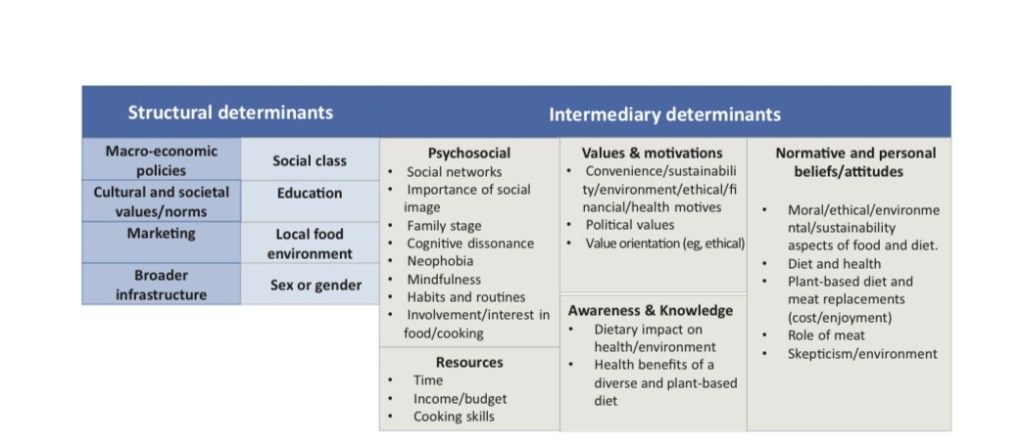
See Figure 1 for an overview of the numerous factors influencing the adoption of sustainable diets, including structural determinants and intermediary determinants.
Figure 1: Structural determinants and intermediary determinants of sustainable diets
“Considering the centrality of human health in current consumer conceptualizations of the term sustainable diet, and in dietary motivations, public health professionals are central to promoting a more holistic understanding of the term. Correspondingly, 3 key actions to facilitate progress toward more sustainable diets are recommended. “
“First, sustained efforts are needed from public health professionals to encourage a realignment of the term sustainable diet with its multidimensional meaning by championing an ecological public health approach in all efforts aimed at promoting more sustainable consumption from awareness raising to policy development.
Second, a broader research lens should be focused on the multidimensional concept of sustainability in the literature exploring consumer attitudes and behaviors.
And third, the development of multidisciplinary, clear, and evidence-based sustainable eating messages, including holistic sustainable dietary guidance, is needed to address knowledge gaps, minimize conflicting narratives, and build consumer agency.
Although more research that accounts for country-specific sociocultural, and economic considerations will be essential to developing these messages and strategies for supporting more sustainable diets, the existing literature highlights several considerations and specific actions targeting various challenges [See Tables 1–2 below] that can be pursued in the meantime to encourage and support more sustainable diets.”
Tables 1 and 2 include a summary of actions and strategies necessary to facilitate the adoption of sustainable diets (Kenny et. 2023).

References
Kenny TA, Woodside JV, Perry IJ, Harrington JM. Consumer attitudes and behaviors toward more sustainable diets: a scoping review. Nutrition Reviews. 2023:nuad033.
Burlingame B, Dernini S. Sustainable Diets and Biodiversity: Directions and Solutions for Policy, Research and Action. Rome, Italy: Food and Agriculture Organization; 2010;307.
 Sustainable RDN