According to a new study published in the journal Nature Communications, “Replacing 50% of meat and milk products with plant-based alternatives by 2050 can reduce agriculture and land use related greenhouse gas (GHG) emissions by 31% and halt the degradation of forest and natural land.” (Kozicka et al., 2023)
The authors note that, “additional climate and biodiversity benefits could accrue from reforesting land spared from livestock production when meat and milk products are substituted by plant-based alternatives, more than doubling the climate benefits and halving future declines of ecosystem integrity by 2050. The restored area could contribute up to 25% of the estimated global land restoration needs under Target 2 of the Kunming Montreal Global Biodiversity Framework by 2030.”
“Understanding the impacts of dietary shifts expands our options for reducing GHG emissions. Shifting diets could also yield huge improvements for biodiversity,” notes study lead author Marta Kozicka, a researcher in the IIASA Biodiversity and Natural Resources Program.
“Plant-based meats are not just a novel food product, but a critical opportunity for achieving food security and climate goals while also achieving health and biodiversity objectives worldwide. Yet, such transitions are challenging and require a range of technological innovations and policy interventions,” adds study coauthor Eva Wollenberg from Alliance of Bioversity International and CIAT and the Gund Institute, University of Vermont.
“The authors developed scenarios of dietary changes based on plant-based recipes for beef, pork, chicken, and milk. The recipes were designed to be nutritionally equivalent to the original animal-derived protein products and realistic for the existing food manufacturing capabilities and globally available production ingredients.” (See Figure 1)
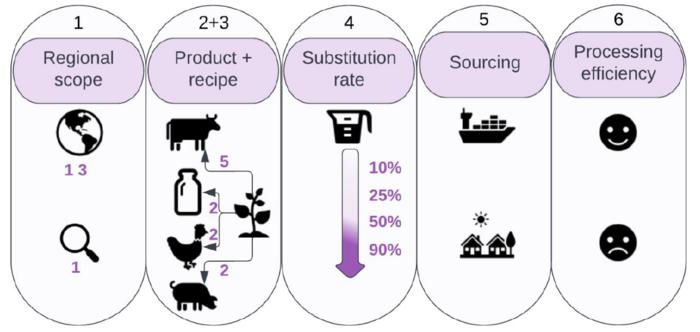
Figure 1. The substitution in the scenarios of plant-based market development is defined along six dimensions: 1) regional scope (13 regions), 2) meat product (i.e., pork, chicken, milk, & beef), 3) recipe type (e.g., soy, pea, nut, etc.), 4) scenario substitution rate (10-19%), 5) international or domestic sourcing of ingredients, and 6) efficiency of converting crops into processed products. (Kozicka et al., 2023)
“The authors found that a 50% substitution scenario would substantially reduce the mounting impacts of food systems on the natural environment by 2050 compared to the reference scenario. The impacts as compared to 2020 include:
- Global agricultural area declines by 12% instead of expanding.
- The decline in areas of forest and other natural land is almost completely halted.
- Nitrogen inputs to cropland are nearly half of the projections.
- Water use declines by 10% instead of increasing.
- Without accounting for any carbon sequestration on spared land, GHG emissions could decline by 2.1 Gt CO2eq year-1 (31%) in 2050 (1.6 Gt CO2eq year-1 on average in 2020–2050).
- Undernourishment globally declines to 3.6%, as compared to 3.8% in the reference scenario (reducing the number of undernourished people by 31 million).”
The full environmental benefit of diet shifts can be achieved if the agricultural land spared from livestock and feed production is restored through biodiversity-minded afforestation. In the 50% scenario, the benefits from reduced land-use emissions could double as compared to a scenario without afforestation – a total reduction of 6.3 Gt CO2eq year-1. At 90% substitution, the reduction of all agriculture and land-use emissions would increase to 11.1 Gt CO2eq year-1 in 2050. (Kozicka et al., 2023)
The restoration of forest ecosystems would also improve biodiversity. The 50% scenario would reduce predicted declines in ecosystem integrity by more than half, while the 90% scenario could reverse biodiversity loss between 2030 and 2040.
“While the analyzed dietary shifts serve as a powerful enabler for reaching climate and biodiversity goals, they must be accompanied by targeted production side policies to deliver their full potential. Otherwise, these benefits will be partly lost due to production extensification and resulting GHG and land-use efficiency losses,” explains IIASA Biodiversity and Natural Resources Program Director Petr Havlík, who coordinated the study.
The study points out that impacts across regions could differ due to differences in population size and diets, unequal agricultural productivity, and participation in international trade of agricultural commodities. The main impacts on agricultural input use are in China and on environmental outcomes in Sub-Saharan Africa and South America. These regional differences could also be used to design better interventions.
“A global introduction of all novel alternatives has additional benefits compared to the scenarios with limited product or geographical scope, but regional substitution of specific products may be highly effective, especially if combined with regional strategies and purposeful selection of recipes,” Kozicka explains.
While the results support the increased use of plant-based meat substitutes, the authors recognize that livestock are a valuable source of income and nourishment for smallholders in low- and middle-income countries, and have significant cultural roles, reduce risk, and diversify smallholder income. Simultaneously, climate change threatens the livelihoods of smallholder farmers. Rapid policy and management action to avoid environmental risk and support farmers and other livestock value chain actors for a socially just and sustainable food system transition will therefore be crucial. This is particularly important considering recent setbacks to achieving food security globally.’ (Kozicka et al., 2023)
Lower nutritional quality in selected vegetarian meat substitutes: Research from Sweden
One of the caveats of plant-based meat alternatives from a health perspective was pointed out in a recent Swedish study published in the journal Nutrients. The study was conducted by scientists at the Chalmers University of Technology in Sweden (Mayer Labba et al., 2022).
These researchers found that many of the meat substitutes sold in Sweden claim a high content of iron — but in a form that cannot be absorbed by the body.
A research team in the Division of Food and Nutrition Science at Chalmers University of Technology analyzed 44 different meat substitutes sold in Sweden. These products are mainly manufactured from soy and pea protein, but also include the fermented soy product tempeh and mycoproteins, that is, proteins from fungi.
Among the products studied, the researchers saw a wide variation in nutritional content and how sustainable they can be from a health perspective. In general, the estimated absorption of iron and zinc from the products was very low. This is because these meat substitutes contained high levels of phytates, antinutrients that inhibit the absorption of minerals in the body,’ says Cecilia Mayer Labba, the study’s lead author.
Phytates are found naturally in beans and cereals — they accumulate when proteins are extracted for use in meat substitutes. In the gastrointestinal tract, where mineral absorption takes place, phytates form insoluble compounds with essential dietary minerals, especially non-heme iron (iron found in plant foods) and zinc, which means that they cannot be absorbed in the intestine.
When it comes to minerals in meat substitutes, the amount that is available for absorption by the body is an important consideration. One needs to look beyond the list of ingredients. Some of the products studied in Sweden were fortified with iron but it is still inhibited by phytates. Ann-Sofie Sandberg, Professor of Food and Nutrition Science at Chalmers and co-author of the study, argues that making nutrition claims allowable on only those nutrients that can be absorbed by the body could create incentives for the industry to improve those products. (Chalmers University of Technology, 2022)
The food industry needs new methods
In the Swedish study, “Tempeh, made from fermented soybeans, differed from the other meat substitutes in the amount of iron available for absorption by the body. This was expected, as the fermentation of tempeh uses microorganisms that break down phytates. Mycoproteins stood out for their high zinc content, without containing any known absorption inhibitors. However, according to the researchers, it is still unclear how well our intestines can break down the cell walls of mycoprotein and how this in turn affects the absorption of nutrients.
‘Plant-based food is important for the transition to sustainable food production, and there is huge development potential for plant-based meat substitutes. The food industry needs to think about the nutritional value of these products and to utilize and optimize known process techniques such as fermentation, but also develop new methods to increase the absorption of various important nutrients,’ says Cecilia Mayer Labba. (Chalmers University of Technology, 2022)
Production of plant proteins
- Most existing plant-based protein products on the market are based on protein extracted from a cultivated plant, such as soybeans, and separated from the plant’s other components.
- The protein is then subjected to high pressure and temperature, which restructures the proteins, known as *texturization, so that a product can be achieved that is meatier and chewier in combination with other ingredients.
- Chalmers’ study shows that the nutritional value of meat substitutes available today is often deficient depending on the choice of raw material (often imported soy) and processing conditions (content of anti-nutrients), and on additives (fat quality and salt).
- A meal containing 150 grams of meat substitutes contributes up to 60 per cent of the maximum recommended daily intake of salt, which according to the Nordic Nutrition Recommendations is 6 grams. (Chalmers University of Technology, 2022)
Are Plant-Based Meat Substitutes Healthy and Environmentally Sustainable?
For more on the pros and cons of consuming plant-based meat substitutes, see these easy-to-read articles. They are written and reviewed by registered dietitians (RDs)/registered dietitian nutritionists (RDNs):
Are Plant-Based Meat Substitutes Healthy? What You Need to Know (March 20, 2023)
https://www.bhg.com/recipes/healthy/eating/is-plant-based-meat-healthy/
We Tried the Impossible Burger: A Dietitian’s View (September 15, 2022)
https://www.healthline.com/nutrition/impossible-burger
References:
Kozicka, M., Havlík, P., Valin, H., Wollenberg, E., Deppermann, A., Leclère, D., Lauri, P., Moses, R., Boere, E., Frank, S., Davis, C., Park, E., Gurwick, N. (2023). Feeding climate and biodiversity goals with novel plant-based meat and milk alternatives. Nature Communications DOI: 10.1038/s41467-023-40899-2
Plant-based food alternatives could support a shift to global sustainability. EurekAlert! AAAS. September 12, 2023. Available at: https://www.eurekalert.org/news-releases/1001106?fbclid=IwAR1cpBvGPzESm9RBQwd0qI96RSft-nLahUiOALzzBeD4LG0jR7-AcS1cV9s
Osmanski S. Is the Impossible Burger Healthy? Here’s How It Compares to Beef. Green Matters. August 3, 2023. Available at: https://www.greenmatters.com/p/is-impossible-burger-healthy.
Fernando D. How the Fat Content 0f Impossible Burgers Compares to Real Beef. Tasting Table. June 25, 2023. Available at: https://www.tastingtable.com/1320675/how-fat-content-impossible-burgers-compares-real-beef/
Mayer Labba, I.-C., Steinhausen, H., Almius, L., Bach Knudsen, K.E., Sandberg, A.-S. Nutritional Composition and Estimated Iron and Zinc Bioavailability of Meat Substitutes Available on the Swedish Market. Nutrients 2022, 14, 3903. https://doi.org/10.3390/nu14193903
Chalmers University of Technology, Sweden. Low nutritional quality in many vegetarian meat substitutes. Science Daily News. December 8, 2022. Available at: https://www.sciencedaily.com/releases/2022/12/221208085718.htm
Osmanski S. Impossible Foods reformulates to have less fat than beef. Food Dive. August 30, 2022. Available at: https://www.fooddive.com/news/impossible-foods-reformulates-less-fat-than-beef/630756/
 Sustainable RDN