A recent study published in the journal Nature Food found that big meat-eaters in the United Kingdom (UK) reducing their meat consumption would be the equivalent of taking 8 million cars off the road.
Prof Scarborough, who is part of the Livestock Environment And People (LEAP) project surveyed 55,000 people who were divided into big meat-eaters, who ate more than 100g of meat a day, which equates to a big burger, low meat-eaters, whose daily intake was 50g or less, approximately a couple of chipolata sausages, fish-eaters, vegetarians and vegans.
While it is well-established that producing meat has a bigger environmental footprint than plant-based food, it has never been calculated in such detail before. “What makes this assessment different is that it takes real people’s diets and is based on the various production methods we have at the moment,” said Professor Susan Jebb, head of the Food Standards Agency and a world leading nutrition scientist at Oxford University, who was not involved in the research.
“The researchers have assessed at a much more granular level than has been done before the environmental footprint of what they are eating.” Their research shows that a big meat-eater’s diet produces an average of 10.24 kg of planet-warming greenhouse gases each day. A low meat-eater produces almost half that at 5.37 kg per day. And for vegan diets – it’s halved again to 2.47 kg a day.
Based on these data, authors concluded that: “[T]here is a strong relationship between the amount of animal-based foods in a diet and its environmental impact, including GHG emissions, land use, water use, eutrophication and biodiversity. Dietary shifts away from animal-based foods can make a substantial contribution to reduction of the UK environmental footprint.”

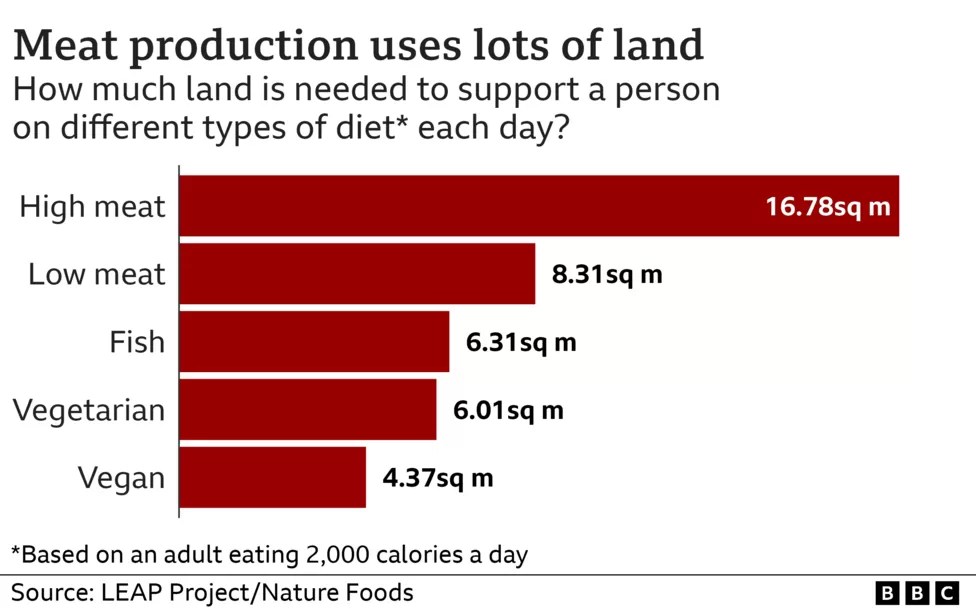

The authors of the UK study further noted that, “Uncertainty due to region of origin and methods of food production do not obscure these differences between diet groups and should not be a barrier to policy action aimed at reducing animal-based food consumption.”
Elsewhere it has been argued that reductions in emissions from livestock on the supply side through use of seaweed feeds might not reduce the sector’s overall carbon footprint if meat-eating continues to increase.” (Nature, Editorial, August 24, 2023).
A new US-based study published in journal Nutrients found that: “Disproportionate beef diets were consumed by 12% of individuals [based on NHANES data], but accounted for half of all beef consumed. Males were more likely than females (p < 0.001) to consume these diets… Older adults, college graduates, and those who looked up the MyPlate educational campaign online were less likely (p < 0.01) to consume a disproportionate beef diet. While almost one-third of reported consumption came from cuts of beef (e.g., steak or brisket), six of the top ten beef sources were mixed dishes: burgers, meat mixed dishes, burritos and tacos, frankfurters, soups, and pasta. Efforts to address climate change through diet modification could benefit from targeting campaigns to the highest consumers of beef, as their consumption accounts for half of all beef consumed” (Willits-Smith et al., 2023).
To add more plant-based meals in your diet, here are some simple, nutritious and meatless recipes from Stephanie Sacks, a culinary nutritionist:
Simple, nutritious, and delicious meatless recipes
https://www.ewg.org/consumer-guides/simple-nutritious-and-delicious-meatless-recipes
Savory Lentil Sloppy Joe

Note: I have made this recipe omitting the ghee (first ingredient) and it was still excellent!
References
Scarborough, P., Clark, M., Cobiac, L. et al. Vegans, vegetarians, fish-eaters and meat-eaters in the UK show discrepant environmental impacts. Nature Food 2023, 4, 565–574. https://doi.org/10.1038/s43016-023-00795-w.
Singh V. Reducing meat consumption equivalent to taking 8mn cars off road: Study. WION. July 21, 2023. Available at: https://www.wionews.com/science/reducing-meat-consumption-equivalent-to-taking-8mn-cars-off-road-study-618090
Ghosh P. Eating less meat ‘like taking 8m cars off road.’ BBC News. July 20, 2023. Available at: https://www.bbc.com/news/science-environment-66238584
Buy one, get one free does not work for the planet. Tackle ever-growing consumption to safeguard sustainability gains. (editorial). Nature. 2023, 620. August 24, 2023. Available at: https://www.nature.com/articles/d41586-023-02596-4
Willits-Smith, A, Odinga, H, O’Malley, K, Rose, D. Demographic and socioeconomic correlates of disproportionate beef consumption among US adults in an age of global warming. Nutrients 2023, 15, 3795. https://doi.org/10.3390/nu15173795
 Sustainable RDN
Meat is the biggest problem in sustainability. Thank you 🙏🌍
LikeLike
In Colombia, food insecurity and lack of sustainability are about poverty, inequality, and the need for land reform as opposed to only land-sparing approaches to agriculture and reducing meat consumption by the wealthy. Such changes won’t come easy and a bill that has been introduced here has already generated controversy by those who own the land to raise and export cattle etc.
Colombia’s ranchers federation threatens to mobilize over land reform
https://colombiareports.com/colombias-ranchers-federation-threatens-to-mobilize-over-land-reform/
“In order to facilitate a land reform and the restitution of stolen land, the Agriculture Ministry wants to create so-called “Peasant Assemblies for Land,” according to the draft bill.”
LikeLike