Happy Stop Food Waste Day (April 27, 2022)! To raise awareness of Stop Food Waste Day, a digital food waste cookbook for home cooks has been published. It features recipes from 45 Compass Group chefs across 30 countries. These recipes give a second life to ingredients that most commonly go to waste in home kitchens, including stale bread, bruised fruit & vegetables, and discarded peels. This food waste cookbook can be downloaded as a PDF at: https://www.stopfoodwasteday.com/en/cookbook.html
Finally, the Harvard Law School Food Law and Policy Clinic, the Natural Resources Defense Council (NRDC), ReFED and World Wildlife Fund (WWF) have released a report detailing how U.S. lawmakers can take action to reduce food waste in the 2023 Farm Bill. See below URL to download a copy of this new report.
Opportunities to Reduce Food Waste in the 2023 Farm Bill (Report)
“By 2030, our routine food choices will be climate-directed. The companies that mobilize now will win the future of food.” With that said, global management consulting firm Kearney has released its 2022 Earth Day Survey, which measures the growing momentum of ‘climavorism’ among consumers – referring to the making of mindful food choices based on environmental impact.
This year’s survey polled 1,000 US consumers on their awareness of, and reaction to, the connection between food preferences and climate change concerns. The results showed many consumers had awareness of the issue and were willing to shift food purchasing behaviors.”
“Climavores believe switching protein sources—from, say, beef to chicken, or pork to soy—goes a long way toward amplifying their personal environmental impact. Eighty-three percent said once a week they would be willing to substitute fish, chicken, pork, or plant-based protein for beef. Consumers most prefer fish and chicken when considering substituting beef to improve environmental impact.”
According to the survey results, four out of five consumers have at least some awareness of the environmental impacts of food. See Figure 4 below. Younger consumers (18-44) are 1.5-2.0 times more likely to consider the environmental impact of their food choices decisions than older consumers.
Environmental impact is valued almost twice as much in grocery stores than in restaurants. Twenty-seven percent of respondents indicated environmental issues were a significant influence on their specific food choices in the grocery store, compared to 21 percent in online purchases, and only 15 percent in restaurants. Figure 1 (see below) highlights how environmental impact of food ranks compared to other significant factors such as cost, taste, and nutrition (in grocery stores, online purchases, and restaurants).
Cost perception and aversion to plant-based diets are the most significant obstacles to making food choices which minimize environmental impact. “The study also uncovered a more negative consumer response to plant-based food alternatives, with 19% of respondents stating they were likely to purchase such products in the next 12 months, down from 31% in 2021.
Relating to this, a growing number of plant-based insiders argue that too many processed ingredients and questionable sustainability claims are plaguing the industry, and have begun to call for reform. How plant-based companies respond to consumer surveys such as these remains to be seen. But the effect of the ‘climavores’ cannot be ignored.”
In a recent study published in Environmental Science & Technology, Dr. Martin Wagner and co-authors investigated whether everyday plastic consumer products contain chemicals that induce adipogenesis, a key process in the development of obesity. These investigators found that, indeed, the chemicals extracted from one third of the products trigger the differentiation and proliferation of adipocytes or fat cells, which were developing towards an unhealthy phenotype. They also showed that plastics contain known metabolism-disrupting chemicals but believe that other, so far unknown, plastic chemicals caused these effects. Based on their new findings, these researchers argue that plastics may represent an underestimated environmental factor contributing to obesity.
You can view the recent Collaborative on Health and the Environment webinar with speaker Dr. Martin Wagner titled, “Do chemicals in plastic consumer products contribute to obesity?”, by going to the following URL:
Völker J, Ashcroft F, Åsa Vedøy A, et al. Adipogenic activity of chemicals used in plastic consumer products. Environmental Science & Technology 2022;56 (4):2487-2496. DOI: 10.1021/acs.est.1c06316
More recently, three scientific reviews published in the journal Biochemical Pharmacology, which cover what obesogens are, how they contribute to obesity, and methods for studying them, point out how paying attention to obesogens can help shift the focus in obesity research from treatment to prevention of obesity. Scientists also call for a reduction in exposure to obesogens, which are ubiquitous in everyday life, as a method to slow the obesity epidemic.
According to Heindel and colleagues (2022), “[o]besogens are a subset of environmental chemicals that act as endocrine disruptors affecting metabolic endpoints. The obesogen hypothesis posits that exposure to endocrine disruptors and other chemicals can alter the development and function of the adipose tissue, liver, pancreas, gastrointestinal tract, and brain, thus changing the set point for control of metabolism. Obesogens can determine how much food is needed to maintain homeostasis and thereby increase the susceptibility to obesity. The most sensitive time for obesogen action is in utero and early childhood, in part via epigenetic programming that can be transmitted to future generations.” Many obesogens are not found in food rather they enter the body through other consumer products, including plastics, makeup, shampoos, and cleaners. Obesogens can also get into food from pesticides and food packaging (van Deelen, 2022).
To reduce exposure to obesogens, one can limit consumption of pre-packaged and highly processed foods (e.g., ultra-processed foods), which often come in containers made with obesogens such as per- and polyfluoroalkyl substances (PFAS) and other plastic additives. Avoiding fruits and vegetables treated with pesticides or buying certified organic produce is another way to reduce exposure (van Deelen, 2022). The Environmental Working Group has their “Dirty Dozen” and “Clean Fifteen” lists so individuals can determine which fruits and vegetables contain the highest and lowest pesticide residues so consumers can make the best decisions for their families. To access these lists, go to: https://www.ewg.org/foodnews/summary.php
Citations:
Lustig RH, Collier D, Kassotis C, et al. Obesity I: Overview and molecular and biochemical mechanisms. Biochem Pharmacol. 2022 Mar 30:115012. doi: 10.1016/j.bcp.2022.115012. Epub ahead of print.
Heindel JJ, Howard S, Agay-Shay K, et al. Obesity II: Establishing causal links between chemical exposures and obesity. Biochem Pharmacol. 2022 Apr 5:115015. doi: 10.1016/j.bcp.2022.115015. Epub ahead of print.
Kassotis CD, Vom Saal FS, Babin PJ, et al. Obesity III: Obesogen assays: Limitations, strengths, and new directions. Biochem Pharmacol. 2022 Mar 26:115014. doi: 10.1016/j.bcp.2022.115014. Epub ahead of print.
Sources:
van Deelen G. Chemicals in everyday products are spurring obesity, warns a new review (April 25, 2022)
A technical report published by the Endocrine Society and the International Pollution Elimination Network (IPEN) titled “Plastics, EDCs & Health” (2020) can be accessed at:
The study, published in the journal Nature, identified for the first time a clear and alarming link between the climate crisis and high-intensity agriculture and showed that, in places where those impacts are particularly high, insect abundance has already dropped by nearly 50%, while the number of species has been slashed by 27%.
These findings raise huge concerns, according to Charlotte Outhwaite, the lead author on the study and researcher at the University College London, given the important role of insects in local ecosystems, pollination and food production, and noted that losing insects could threaten human health and food security.
“Three quarters of our crops depend on insect pollinators,” Dave Goulson, a professor of biology at the University of Sussex in the UK, previously told CNN. “Crops will begin to fail. We won’t have things like strawberries.”
“We can’t feed 7.5 billion people without insects.”
Outhwaite said their findings “may only represent the tip of the iceberg,” because of the limited amount of evidence in some regions.”
Outhwaite, C.L., McCann, P. & Newbold, T. Agriculture and climate change are reshaping insect biodiversity worldwide. Nature (2022). https://doi.org/10.1038/s41586-022-04644-x
Two additional resources on the “insect apocalypse” and “insect crisis” are the following books: “Silent Earth: Averting the Insect Apocalypse” (2021) and “The Insect Crisis: The Fall of Tiny Empires That Run the World” (2022).
From Deloitte’s new Sustainable Actions Index comes a portrait of people bringing sustainability into the mainstream.
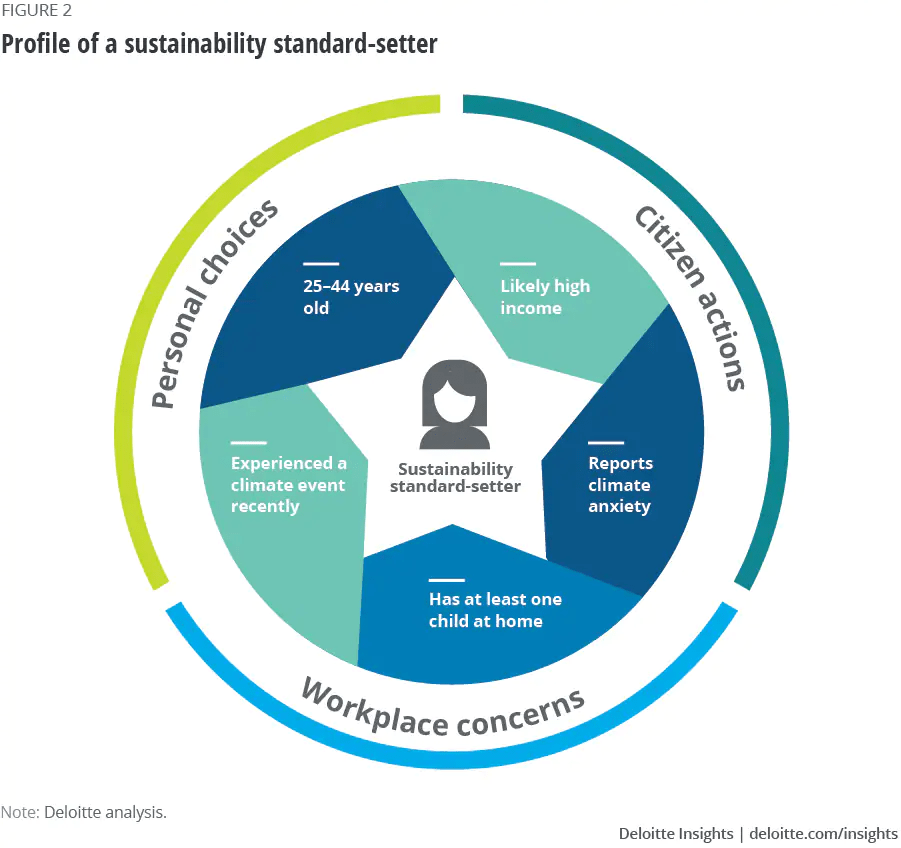
Deloitte conducted a global survey of 23,000 people in 23 countries on their attitudes, behaviors, and choices related to environmental sustainability in September 2021. Responses were concentrated in North America, Europe, and East and South Asia. The researchers assessed three main spheres of how sustainability factored into respondents’ lives: home(personal choices), workplace concerns, and citizen actions. Respondents were divided into three groups based on their Sustainable Actions index score: behavioral bystanders (low), the movable middle (medium), and sustainability standard-setters (high), respectively.
Their analysis focused on the latter group, sustainability standard-setters, as “[r]esearch on social movements and change suggests that a relatively small number of dedicated individuals can catalyze much wider and more rapid shifts in the broader environment.”
The researchers found that across geographies, “a “typical” sustainability standard-setter, among respondents participating in the survey, identifies as female; is 25-44 years old; is a high-income earner; has felt worried or anxious about climate change recently; has at least one child at home; and experienced at least one climate event over the last six months.” See Figure 2 below. Furthermore, there were “five noteworthy demographic and attitudinal factors that especially correlated to people’s sustainability behaviors, namely: belief in climate change; direct experience of climate events; level of optimism about the prospects of global climate action; the presence of children at home; and age.” Finally, the Sustainable Actions Index “offers considerations for leaders across domains who seek to encourage sustainable behaviors. These include: prepare for change; nurture a narrative of change; and encourage change.”
In a new study published in the Journal of Business Research, researchers examined “the role of consumer personality traits as drivers of fair trade engagement and its subsequent impact on ethically-minded behavior concerning circular economy issues.” The authors found that “extraversion, agreeableness, and conscientiousness positively affect consumer fair trade engagement, whereas neuroticism has a negative effect, and openness has no significant impact. Consumer fair trade engagement was subsequently revealed to positively influence ethically-minded behavior related to circular economy. The association between consumer fair trade engagement and ethically-minded behavior was stronger in older, more educated, and high-income consumers, whereas gender had no moderating role.”
“In our current economy, we take materials from the Earth, make products from them, and eventually throw them away as waste – the process is linear. In a circular economy, by contrast, we stop waste being produced in the first place.”
The circular economy is based on three principles, driven by design:
Note: Be sure to see the Ellen MacArthur Foundation report, “The Big Food Redesign. Regenerating Nature With The Circular Economy” which is available at the above web link.
To read the new study published in the Journal of Business Research, go to:
Kutaula S, Gillani A, Leonidou LC, et al. Integrating fair trade with circular economy: personality traits, consumer engagement, and ethically-minded behavior. Journal of Business Research 2022;144:1087-1102. https://doi.org/10.1016/j.jbusres.2022.02.044
“A groundbreaking new study finds that coffee beans are bigger and more plentiful when birds and bees team up to protect and pollinate coffee plants.
Without these winged helpers, some traveling thousands of miles, coffee farmers would see a 25% drop in crop yields, a loss of roughly $1,066 per hectare of coffee.
That’s important for the $26 billion coffee industry — including consumers, farmers, and corporations who depend on nature’s unpaid labor for their morning buzz — but the research has even broader implications.”
The study [published] in the Proceedings of the National Academy of Sciences is the first to show, using real-world experiments at 30 coffee farms, that the contributions of nature — in this case, bee pollination and pest control by birds — are larger combined than their individual contributions.
“Until now, researchers have typically calculated the benefits of nature separately, and then simply added them up,” says lead author Alejandra Martínez-Salinas of the Tropical Agricultural Research and Higher Education Center (CATIE). “But nature is an interacting system, full of important synergies and trade-offs. We show the ecological and economic importance of these interactions, in one of the first experiments at realistic scales in actual farms.”
“These results suggest that past assessments of individual ecological services — including major global efforts like IPBES — may actually underestimate the benefits biodiversity provides to agriculture and human wellbeing,” says Taylor Ricketts of the University of Vermont’s Gund Institute for Environment. “These positive interactions mean ecosystem services are more valuable together than separately.”
“For the experiment, researchers from Latin America and the U.S. manipulated coffee plants across 30 farms, excluding birds and bees with a combination of large nets and small lace bags. They tested for four key scenarios: bird activity alone (pest control), bee activity alone (pollination), no bird and bee activity at all, and finally, a natural environment, where bees and birds were free to pollinate and eat insects like the coffee berry borer, one of the most damaging pests affecting coffee production worldwide.
The combined positive effects of birds and bees on fruit set, fruit weight, and fruit uniformity — key factors in quality and price — were greater than their individual effects, the study shows. Without birds and bees, the average yield declined nearly 25%, valued at roughly $1,066 per hectare.”
Citation: Martinez-Salinas A, Chain-Guadarrama A, Aristizabal N, et al. Interacting pest control and pollination services in coffee systems. Proc. Natl. Acad. Sci. U.S.A. 2022;119(15): https://doi.org/10.1073/pnas.2119959119
In a new study published in the Proceedings of the National Academy of Sciences, researchers simulated the potential effects of dietary shifts and food waste reduction on the biodiversity impacts of food consumption in the United States. The authors found that “[a]dopting the [EAT-Lancet] Planetary Health diet or the US Department of Agriculture (USDA)–recommended vegetarian diet nationwide would reduce the biodiversity footprint of food consumption. However, increases in the consumption of foods grown in global biodiversity hotspots both inside and outside the United States, especially fruits and vegetables, would partially offset the reduction…. Simply halving food waste would benefit global biodiversity more than half as much as all Americans simultaneously shifting to a sustainable diet. Combining food waste reduction with the adoption of a sustainable diet could reduce the biodiversity footprint of US food consumption by roughly half. Species facing extinction because of unsustainable food consumption practices could be rescued by reducing agriculture’s footprint; diet shifts and food waste reduction can help us get there.”
Citation: Read QD, Hondula KL, Muth MK, et al. Biodiversity effects of food system sustainability actions from farm to fork. Proc. Natl. Acad. Sci. USA. 119(5):e2113884119 (2022).
Reacting to the publication of the Intergovernmental Panel on Climate Change (IPCC) report on the mitigation of climate change…, experts from IPES-Food called for fundamental reform of food systems to avoid catastrophic levels of global warming. The IPCC report, agreed by governments and scientists, finds that:
We are nowhere near on track to achieve the Paris Agreement targets of keeping global warming below 2°C, and ideally 1.5°C.
Investment levels are insufficient to stay Paris aligned and investment gaps are widest for the agriculture, forest and land sector and for developing countries. Investment levels must increase by 3 to 6 times current levels to limit warming to below 2°C.
Agriculture and land use* account for nearly a quarter of GHG emissions and keep rising. Transforming farming and livestock can reduce emissions and draw down carbon.
Demand-side mitigation efforts across all sectors – including lifestyle changes, reduction of food waste, and shift to sustainable diets [e.g., increase consumption of plant-based foods and decrease excess meat consumption] – can result in a 40-70% reduction in greenhouse gas emissions by 2050; and can improve health and wellbeing.
For emissions that are extremely hard or impossible to reduce, removing carbon dioxide from the atmosphere and storing it is required. But there are limits to how possible this is and entails risks for ecosystems, livelihoods and health.
*“Land use practices such as agroforestry, intercropping, organic inputs, cover crops, and rotational grazing can provide mitigation and support adaptation to climate change via food security, livelihoods, biodiversity, and health co-benefits.” (IPCC, 2022)
For more information, see: Climate Change 2022: Mitigation of Climate Change
“The Working Group III report provides an updated global assessment of climate change mitigation progress and pledges, and examines the sources of global emissions. It explains developments in emission reduction and mitigation efforts, assessing the impact of national climate pledges in relation to long-term emissions goals.”
This self-study continuing education course, which was approved by the Commission on Dietetic Registration (CDR) to offer 2 CPEUs, provides an overview of the EAT-Lancet Commission’s planetary health diet, a largely plant-based flexitarian diet; discusses the principles of a flexitarian diet; describes the nutritional advantages of a flexitarian diet; examines the health and environmental benefits of a flexitarian diet; and provides strategies RDNs can use when counseling their clients on implementing a flexitarian diet.
Since this course was written, two additional studies on the Eat-Lancet planetary health diet have been published, one authored by Stubbendorff et al. (2022) and another by Sun et al. (2022). See below URLs to access these additional articles (references).
References:
Stubbendorff A, Sonestedt E, Ramne S, Drake I, Hallström E, Ericson U. Development of an EAT-Lancet index and its relation to mortality in a Swedish population, The American Journal of Clinical Nutrition, 2022;115(3):705–716, https://doi.org/10.1093/ajcn/nqab369
Sun Z, Scherer L, Tukker A. et al. Dietary change in high-income nations alone can lead to substantial double climate dividend. Nature Food, 2022;3:29–37, https://doi.org/10.1038/s43016-021-00431-5







 Sustainable RDN