“An international team of scientists has reported that people gain more weight on an ultra-processed diet compared to a minimally processed diet, even when they eat the same number of calories. The study in humans also revealed that a diet high in ultra-processed foods introduces higher levels of pollutants known to affect sperm quality (Preston et al., 2025). The findings were published in the journal Cell Metabolism.”

“Our results prove that ultra-processed foods harm our reproductive and metabolic health, even if they’re not eaten in excess. This indicates that it is the processed nature of these foods that makes them harmful,” says Jessica Preston, lead author of the study, who carried out the research during her PhD at the University of Copenhagen’s NNF Center for Basic Metabolic Research (CBMR).” (University of Copenhagen, 2025; Preston et al., 2025)
Study Highlights
- Compared with an unprocessed diet, a UPF (ultra-processed food) diet impaired cardiometabolic and reproductive health
- The deleterious effects of a UPF (ultra-processed food) diet were independent of total caloric intake
- A UPF diet altered the balance of several hormones, including GDF-15 (growth differentiation factor 15) and FSH (follicle-stimulating hormone)
- A UPF diet was associated with higher serum concentration of the phthalate cxMINP
(Preston et al., 2025)
Same calories, different outcomes
“To get the best possible data, the scientists compared the health impact of unprocessed and ultra-processed diets on the same person. They recruited 43 men aged 20 to 35 [years old], who spent three weeks on each of the two diets, with three months ‘washout’ in between.
Half [of the men] started on the ultra-processed and half started on the unprocessed diet. Half of the men also received a high-calorie diet with an extra 500 daily calories, while half received the normal amount of calories for their size, age and physical activity levels. They were not told which diet they were on. Both the unprocessed and ultra-processed diets had the same amount of calories, protein, carbs and fats.
Men gained around 1 kg more of fat mass while on the ultra-processed diet compared to the unprocessed diet, regardless of whether they were on the normal or excess calorie diet. Several other markers of cardiovascular health were also affected.” (University of Copehhagen, 2025; Preston et al., 2025)
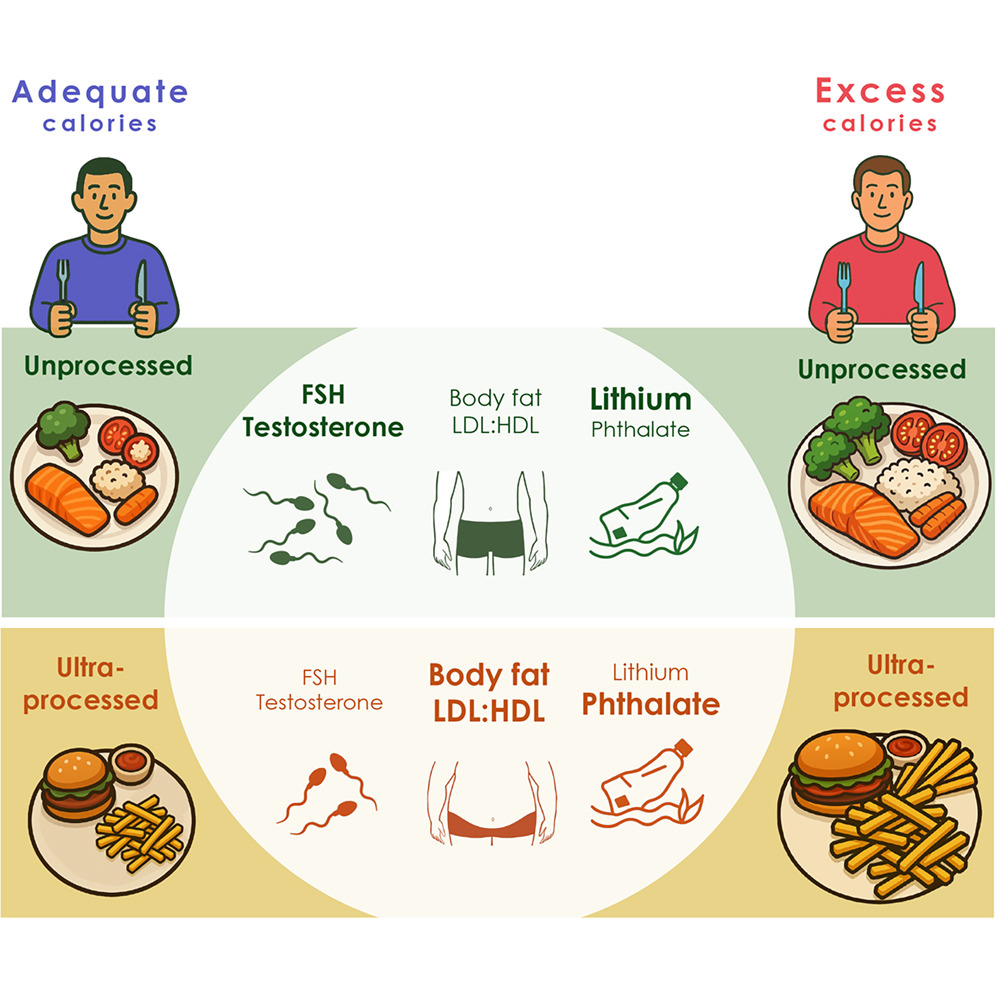
Ultra-processed foods are polluted with endocrine disruptors
“The scientists also discovered a worrying increase in the level of the hormone-disrupting [endocrine-disrupting] phthalate cxMINP, a substance used in plastics, in men on the ultra-processed diet. Men on this diet also saw decreases in their levels of testosterone and follicle-stimulating hormone, which are crucial for sperm production.
“We were shocked by how many body functions were disrupted by ultra-processed foods, even in healthy young men. The long-term implications are alarming and highlight the need to revise nutritional guidelines to better protect against chronic disease.” says the study’s senior author Professor Romain Barrès from the University of Copenhagen’s NNF Center for Basic Metabolic Research, and the Université Côte d’Azur.” (University of Copenhagen, 2025; Preston et al., 2025)
For more information on the potential negative health impacts of endocrine-disrupting chemicals on human health, see the in-depth report published by the Endocrine Society and the International Pollutants Elimination Network (IPEN) (2024).
Endocrine Disrupting Chemicals: Threats to Human Health. Pesticides, Plastics, Forever Chemicals, and Beyond (Endocrine Society and IPEN, February 2024)
Also, see the recent scientific brief published by the Endocrine Society (2025) titled:
Making Food Hormone Healthy (Endocrine Society, April 2025)
Conclusion
The authors concluded that, “our results demonstrate that consumption of UPF itself, irrespective of excess caloric intake, is detrimental to human health. Moving dietary patterns away from UPF and toward less-processed alternatives may promote cardiometabolic and mental health, along with amelioration of male reproductive fitness.” (Preston et al., 2025)
References
Endocrine Society. Making Food Hormone Healthy. Endocrine Society: Washington DC. April 2025. Available at: https://www.endocrine.org/-/media/endocrine/files/advocacy/making_food_hormone_healthy_formal.pdf
Gore AC, La Merrill MA, Patisaul H, et al. Endocrine Disrupting Chemicals: Threats to Human Health. Pesticides, Plastics, Forever Chemicals, and Beyond. Endocrine Society and International Pollutants Elimination Network (IPEN). February 2024. Available at: https://ipen.org/sites/default/files/documents/edc_report-2024-final-compressed.pdf
Preston JM, Iversen J, Hufnagel A, Hjort L, Taylor J, Sanchez C, George V, Hansen AN, Ängquist L, Hermann S, Craig JM, Torekov S, Lindh C, Hougaard KS, Nóbrega MA, Simpson SJ, Barrès R. Effect of ultra-processed food consumption on male reproductive and metabolic health. Cell Metab. 2025. S1550-4131(25)00360-2. doi: 10.1016/j.cmet.2025.08.004.
University of Copenhagen (Press Release). Not all calories are equal: Ultra-processed foods harm men’s health. August 28, 2025. Available at: https://cbmr.ku.dk/news/2025/not-all-calories-are-equal-ultra-processed-foods-harm-mens-health/
 Sustainable RDN