“Demand for food products, often from international trade, has brought agricultural land use into direct competition with biodiversity. Where these potential conflicts occur, and which consumers are responsible is poorly understood.” In a recent study published in the journal Proceedings of the National Academy of Sciences (PNAS) (2023), by combining conservation priority maps (CP) with agricultural trade data, researchers estimated the current potential conservation risk hotspots driven by 197 countries across 48 agricultural products (Hoang et al., 2023)
“The study ranks which commodities are sourced from regions with high priority for conservation. While previous studies have quantified the carbon, land, and water footprints of the agriculture industry, the threats to biodiversity and ecosystems from farming are poorly understood and thus often omitted. The new results are expected to assist with the formation of policies that protect biodiversity while preserving global food security.” (Norwegian University of Science and Technology, 2023)
The authors found that: “Globally, a third of agricultural production occurs in sites of high CP (CP > 0.75, max = 1.0). While cattle, maize [corn], rice, and soybean pose the greatest threat to very high-CP sites, other low-conservation risk products (e.g., sugar beet, pearl millet, and sunflower) currently are less likely to be grown in sites of agriculture–conservation conflict.” Furthermore, the authors’ analysis suggests that a commodity can cause dissimilar conservation threats in different production regions.” (Hoang et al., 2023)
Beef, rice and soy biggest footprint
“The international research team, with members from Norway, the Netherlands and Japan, divided agricultural areas into four tiers, based on their conservation priority, from lowest to highest. They then determined which individual agricultural commodities were produced in these different priority levels. See Figure 1 below.
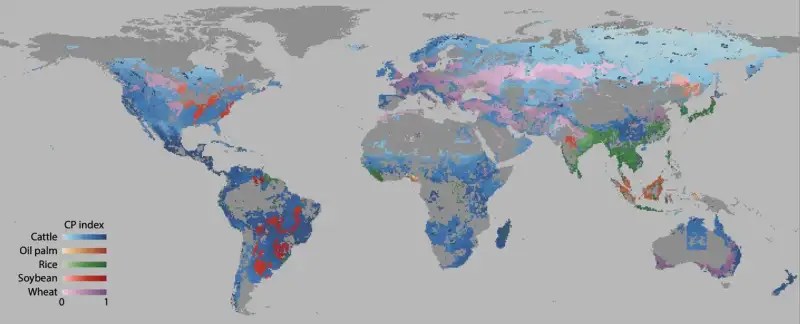
Figure 1. The map shows the land use and conservation priority index for major agricultural commodities. The grid cells are colored according to the dominant crop grown, and the intensity of the color, from lighter to darker shades, indicates the conservation priority of each cell. Credit: Hoang et al. 2023
“The researchers found that about one-third of all farming occurs in areas that were considered highest conservation priority. One pattern that emerged was that some staple commodities, such as beef, rice, and soybeans, tended to be produced in high conservation priority areas. At the same time, other substitutes, such as barley and wheat, were predominantly sourced from lower risk areas.”
“A surprising takeaway for me was how much the impact of the same crop can vary based on where it is sourced from,” said Daniel Moran, a senior scientist at the Climate and Environmental Institute NILU and a research professor at the Norwegian University of Science and Technology’s (NTNU) Industrial Ecology Program who was also a co-author of the study.
Beef and soybeans, for example, are grown in high conservation priority areas in Brazil but not in North America. Similarly, wheat is grown in lower conservation priority areas in Eastern Europe than in Western Europe.” (Norwegian University of Science and Technology, 2023)
International trade a factor
“Coffee and cocoa are primarily grown in high conservation priority areas in equatorial nations, but these cash crops are largely consumed in richer nations like the United States and members of the European Union, the researchers’ model showed. At the global level, China, with its high demand for multiple commodities, has the biggest influence on food production in high priority conservation areas.”
“The study also illustrated how different nations can have sharply different biodiversity food footprints. The United States, EU, China, and Japan all depend heavily on imports to satisfy their demand for beef and dairy. In Japan, more than one-quarter of the beef and dairy consumed in that country comes from high conservation priority areas. For the other regions, that number is closer to just ten percent.”
“That suggests there are opportunities to change the biodiversity footprint of food consumption by simply changing our sourcing of food products,” said Kanemoto.
“While it’s well known that cattle, soybean, and palm oil are farmed in high conservation priority areas, the study found that other commodities, including corn, sugarcane, and rubber, are also problematic and deserve more attention from policymakers.” (Norwegian University of Science and Technology, 2023)
Effects of climate change
“The changing climate is expected to alter both cropping patterns and available habitats. The research team used their model to look at different scenarios to see how the interaction between wild biodiversity and farming would change under predicted 2070 temperatures.
Species are likely to colonize new territories in a warmer world, which could result in the emergence of new high conservation priority areas or mitigate conflicts in current conservation hotspots.”
“While the researchers did not produce a detailed map forecasting future conflicts between agriculture and conservation, the paper’s supporting information offers some estimates of future competition under a range of scenarios.
“Our spatial approach is a valuable complementary method with other standard techniques to evaluate the impact agriculture has on biodiversity. The knowledge gained from our study should help reduce the trade-off many nations associate with agriculture production and environmental protection,” said Kanemoto. “It fills in a big missing piece in the footprint of food.”
“Our lifestyles are causing alarming damage to the atmosphere and water supplies. Farmers and governments worldwide are seeking policies that sustain prosperity while minimizing irreversible harm to the environment. Similar sustainable development policies are needed for agriculture. The calculation of detailed footprints for food and other farmed commodities is crucial to support these policies,” Moran said.” (Norwegian University of Science and Technology, 2023)
The results can be viewed in an interactive map at: https://agriculture.spatialfootprint.com/biodiversity.
References
Hoang, Nguyen Tien et al., Mapping potential conflicts between global agriculture and terrestrial conservation, Proceedings of the National Academy of Sciences (2023). DOI: 10.1073/pnas.2208376120. doi.org/10.1073/pnas.2208376120
Norwegian University of Science and Technology. Mapping the conflict between farming and biodiversity. Phys.Org. May 29, 2023. Available at: https://phys.org/news/2023-05-conflict-farming-biodiversity.amp?fbclid=IwAR0Y_Ju46F9v3M5OQgHnfvx-cewI0gPU1Qab7lGpfcfOnODOtW2mxgRfkB8
 Sustainable RDN