New research published in Food Quality and Preference evaluated the impact of front-of-package warning labels (FOPL) on the purchasing probability of processed and ultra-processed foods in Colombia. More specifically, the study evaluated the impact of black octagonal front-of-package warning labels (FOPL), introduced by Resolution 254 of 2023 (RESOLUCIÓN No. 254), on consumer purchasing intentions for processed and ultra-processed food products in Colombia (Rangel-Quinonez et al., 2025).
The study findings “demonstrated a significant reduction in purchase probability for 20 of the 22 evaluated foods, with an additive effect on the number of labels…. The food products with four labels showed the largest impact while those with a single label exhibited minimal changes. Greater label sensitivity was observed among participants with higher education levels and greater familiarity with nutritional labeling.” Finally, “a marginally significant inverse association was found between product price and the change in purchase probability.” (Rangel-Quinonez et al., 2025)
See Figure 1 for example octagonal FOPL required by Resolution 254 of 2023 in Colombia.

Figure 1. Nutrition warning labels according to Resolution 254 of 2023
Front-of-pack labeling (FOPL) has emerged as a key public health tool to inform consumers about the nutritional quality of foods and encourage healthier purchasing decisions. Front-of-package warning labels have gained prominence in Latin America due to their effectiveness in discouraging the consumption of unhealthy foods and beverages. (Rangel-Quinonez et al., 2025)
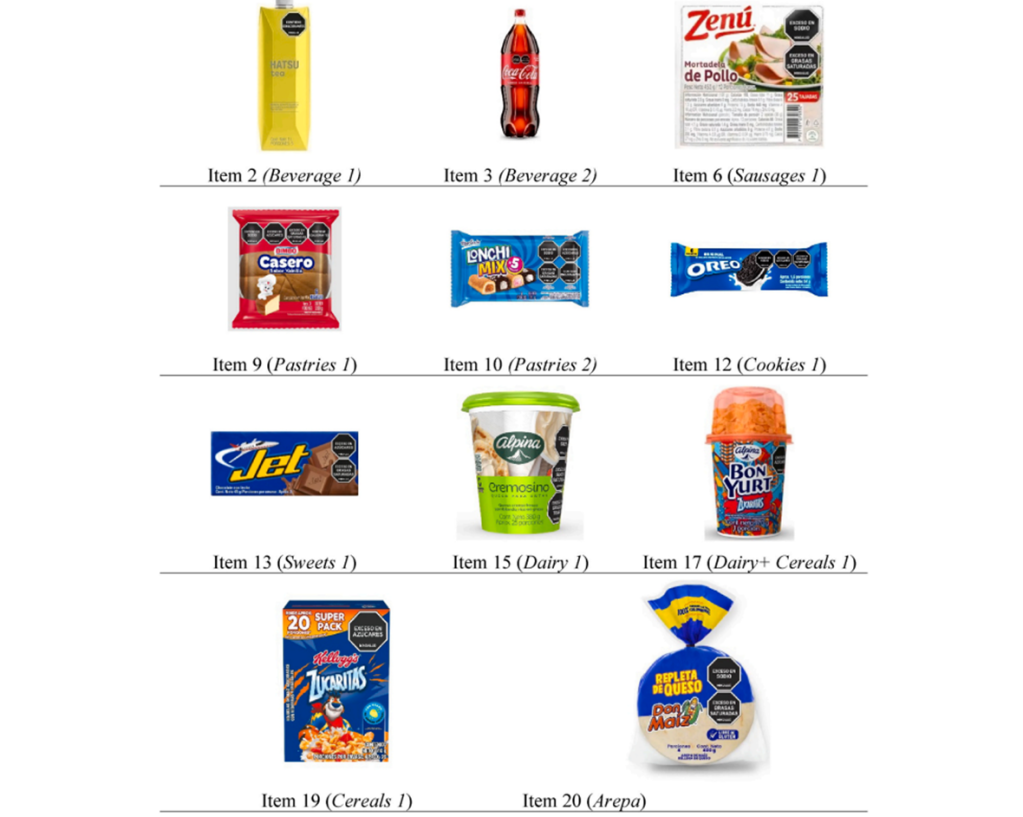
“Unlike studies focusing on purchase intentions derived from hypothetical products, this newly published research used 22 real products with official front-of-package warning labels for actual products that are widely consumed in Colombia.” The front images of the 22 products evaluated during this research study during two different experimental groups are included below in Figure 2. (Rangel-Quinonez et al., 2025)
Trial 1
Trial 2
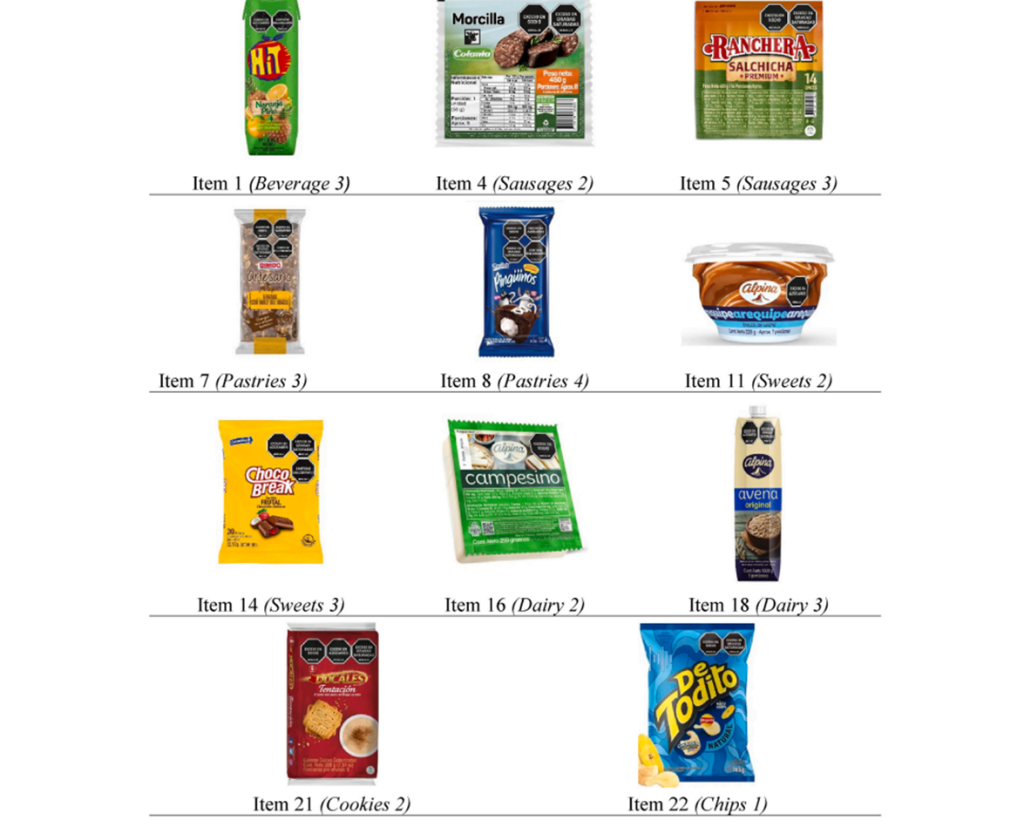
Figure 2. The front images of 22 products that were evaluated in each trial. Participants were randomly assigned to one of two different experimental groups, Trial 1 or Trial 2
The study findings by Rangel-Quinonez et al. (2025) “demonstrated a significant reduction in purchase probability for 20 of the 22 evaluated foods, with an additive effect on the number of labels….” “The food products with four labels showed the largest impact (Cohen’s d = 0.34), while those with a single label exhibited minimal changes (Cohen’s d = 0.17).” “Greater label sensitivity was observed among participants with higher education levels and greater familiarity with nutritional labeling.” Finally, “a marginally significant inverse association was found between product price and the change in purchase probability.” (Rangel-Quinonez et al., 2025)
Effects of FOPL on purchase probability
Figure 3 below summarizes the descriptive statistics of purchase probability for each of the evaluated food items. “Overall, the researchers found that a decrease was observed in both the mean and the standard deviation of purchase probability following the inclusion of warning labels. ” “During the pretest phase, mean values ranged from 0.20 (sd = 0.28) to 0.54 (sd = 0.35), while in the posttest they decreased to a range between 0.18 (sd = 0.26) and 0.48 (sd = 0.31).” (Rangel-Quinonez et al., 2025)
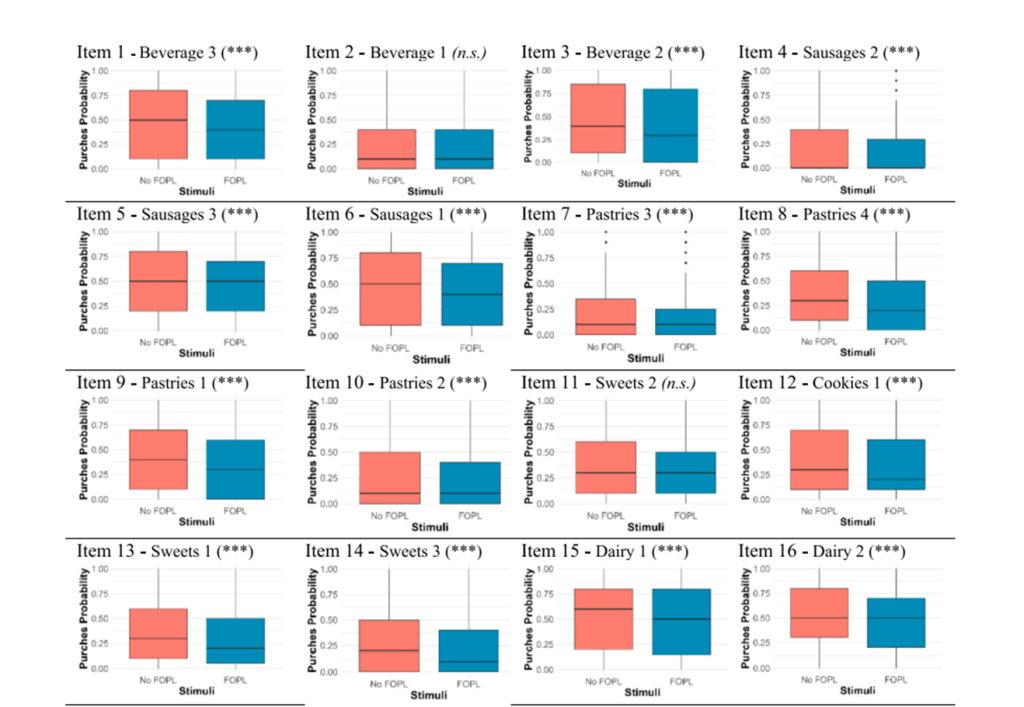


Figure 3. Effects of Front-of-Package Warning Labels on Purchase Probability Across 22 Food Items
Based on these results, the authors concluded, “[t]hese findings offer early evidence on the effectiveness of the Colombian FOPL [front-of-package labeling] policy under ecologically valid conditions and highlight the importance of complementary strategies to enhance its impact across different consumer segments.” (Rangel-Quinonez et al, 2025)
Other recent research by Cadena and colleagues (2025) published in BMC Medicine reported that, “Regulatory actions in Colombia appear to have changed the food landscape, fostering reformulation of UPF [ultra-processed food] that drastically curtail the levels of detrimental nutrients such as sugars and sodium. Forthcoming studies should explore the dietary and health implications of these product changes, in addition to scrutinizing shifts in the use of additives and other ingredients.” (Cadena et al., 2025)
References
Rangel-Quinonez HS, Vecchio R, Arenas-Estevez LF. Impact of new octagonal front-of-pack labeling on purchasing probability of processed and ultra-processed foods in Colombia. Food Quality and Preference. 2025; 133:105640. DOI:10.1016/j.foodqual.2025.105640
Food Regulations in Colombia – May 30, 2024. Available at:
RESOLUCIÓN No. 254. Available at: https://www.studocu.com/co/document/universidad-incca-de-colombia/economia-internacional/resolucion-no-254-de-2023/98095678
Cadena EM, Gallo I, Soto VE. Reformulation of ultra-processed products in Colombia after the introduction of public health regulations. BMC Medicine. 2025;23:446.
 Sustainable RDN