“Green roofs can capture nearly all the microplastic particles that contaminate rainwater in modern cities, according to a new study. The findings add to the list of benefits of green roofs, which have previously been shown to reduce energy needed for heating and cooling buildings and calm the flow of stormwater. These nature-based solutions can offer unexpected co-benefits in mitigating airborne pollution in densely built environments,” says study team member Shuiping Cheng, a researcher at Tongji University in Shanghai, China.” (DeWeerdt, 2025; Huang et al., 2025)

Microplastics—small bits of material formed from the breakdown of everyday plastic products—are ubiquitous. They’re found in soil, water, air, and even our bodies, and it’s increasingly clear that they pose risks to the environment, wildlife, and human health.
Most efforts to capture microplastics in urban environments have focused on filtering them out of surface runoff in bioremediation ponds, swales, and constructed wetlands. Since green roofs are known to filter heavy metals and excess nutrients from runoff, Cheng and his colleagues wondered if they could take care of microplastics as well.” (DeWeerdt, 2025; Huang et al., 2025)
To assess is green roofs could capture microplastics, the researchers “built a simulated roof environment in their lab, where, in a thin layer of fresh soil, they planted two kinds of plants commonly used on rooftops in the city of Shanghai. They also introduced microplastic particles into the air above the plants at levels common to Shanghai. They then conducted simulated rains, measuring microplastic levels on the plants and in the soil.”
“They found that the plants did a good job of pulling the microplastics from the rain, and by extension, the air above them. The green roof system, including the soil layer, pulled approximately 97.5% of the microplastics from the rainwater that landed on it. And after conducting measurements over multiple rains, the team found that the percentage of microplastics removed increased slightly with rainfall intensity.”
“The researchers note that while some microplastics were collected by the leaves, the bulk of the capture was in the soil. They also noted that microplastics shaped like fragments were collected by the soil better than those shaped like fibers.” (Yirka B, 2025; Huang et al., 2025) See Figure 1 below.
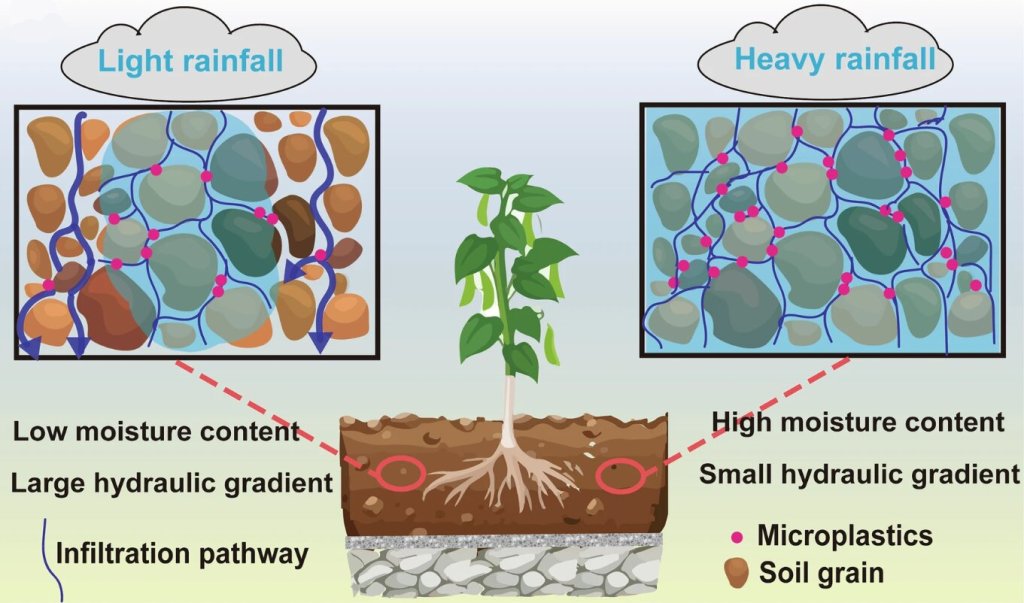
Figure 1. Schematic of the infiltration process affected by the proposed contributor. Specifically, the thick lines represent relatively larger preferential flow channels that exist under low soil moisture conditions, allowing for faster infiltration. In contrast, the thin lines correspond to finer channels formed due to soil swelling under higher moisture conditions, resulting in slower infiltration. Illustration credit: Huang et al. Communications Earth & Environment (2025). DOI: 10.1038/s43247-025-02407-w
Green roofs are not likely to be a “set it and forget it” solution to microplastics. For one thing, the soil could become saturated with microplastics over time. Earthworms might be able to be deployed to break down and metabolize the microplastic fragments, the researchers suggest.
“In addition, the filter and drainage layers of green roofs are sometimes made of plastic, which could become new sources of microplastic pollution themselves, the researchers warn. They buried pieces of polypropylene sheets in the soil of their model green roofs and observed signs of aging and degradation over the course of the experiment.” (DeWeerdt, 2025; Huang et al., 2025)
“A key next step is to validate these results under real-world conditions on full-scale green roofs,” Cheng says. “We are actively exploring opportunities to carry out such long-term field studies to better understand microplastic retention and release dynamics over time.” (DeWeerdt, 2025; Huang et al., 2025)
References
DeWeerdt S. An unexpected green roof benefit: purging urban rainfall of practically all microplastics. Anthropocene Magazine. July 1, 2025. Available at: https://www.anthropocenemagazine.org/2025/07/an-unexpected-green-roof-benefit-purging-urban-rainfall-of-practically-all-microplastics/
Yirka B. Green roofs shown to capture nearly all microplastics from rainwater. Phys.org. June 20, 2025. Available at: https://phys.org/news/2025-06-green-roofs-shown-capture-microplastics.html
Huang, J., Bao, M., Wu, S. et al. Green roofs act as the first barrier to intercept microplastics from urban atmosphere. Commun Earth Environ. 2025;6:452.
 Sustainable RDN