The 2023 report of the State of Food Security and Nutrition in the World (FAO et al., 2023) highlights that up to 783 million people across the globe faced hunger in 2022, while more than 3.1 billion people were unable to afford a healthy diet in 2021. While hunger and food security continue, an estimated 13 percent of the world’s food is lost in the supply chain from post-harvest prior to the retail stage of the supply chain (FAO, 2022); a further 17 percent of food is wasted in households, food services and in retail (UNEP, 2021).

Currently, many of the world’s agrifood systems are unsustainable, as they degrade agricultural land, contribute to greenhouse gas emissions and loss of biodiversity, and consume groundwater. Food systems are also vulnerable to the external climate and other shocks, partly because of the impact on the environment.
Food Systems 2030
“Resetting our food systems is urgent. Food systems have fed a growing population, but the cost is unsustainable. Current food systems often encroach on natural habitats, pollute the planet, exacerbate rural poverty, and underlie ill health and disease. Market and government failures impose high costs on society and the environment.
Poverty and hunger are increasing in the wake of the COVID-19 crisis, while the majority (79%) of the world’s poor continue to live in rural areas. Over 800 million people are hungry and 3 billion people are malnourished.
Food systems produce around a third of global greenhouse gas emissions, while agriculture is the largest user of land and water, accounting for 70 percent of water use. Reducing the emissions of “hidden” environmental, health, and poverty costs estimated at almost US$12 trillion per year, compared to US$10 trillion in market value.
1/3 of food produced globally is either lost or wasted, while food loss and waste is a major contributor to global emissions. Meanwhile, millions of people are either not eating enough or eating the wrong types of food, resulting in a double burden of malnutrition that can exacerbate illnesses and health crises.” (World Bank, 2023)
Food Systems Transformation: The Role of Reducing Food Loss and Waste
Action is required to transform agrifood systems globally, to improve their resilience, efficiency, sustainability, and inclusiveness in ways that positively impact food security, enable healthy diets, and contribute to better nutritional outcomes.
Reducing food loss and waste can play a key role in the transformation of agrifood systems by increasing the availability of food, contributing to food security, healthy diets, and building resilience. Food loss and food waste reduction also serves as a key climate strategy by reducing greenhouse gas emissions (GHGs). It can therefore help countries and businesses to raise climate ambition, while conserving and protecting our ecosystems and natural resources upon which the future of food depends.
The 2030 Agenda for Sustainable Development – specifically SDG 12, Target 12.3 – calls for halving per-capita global food waste at the retail and consumer levels and reducing food losses along production and supply chains. Target 16 of the Kunming Montreal Global Biodiversity Framework (GBF) among other issues, also calls for “halving global food waste by 2030.”
We need to urgently accelerate the pace of actions to reduce food loss and waste, and transform agrifood systems, to meet the SDG 12.3 Target, – with tangible benefits FOR THE PEOPLE! and FOR THE PLANET!
• Agrifood systems encompass farming, harvesting, fishing, livestock rearing, storing, processing, transporting, selling, buying, eating and disposal of our food. They also include non-food resources from agriculture, such as cotton and forest products (FAO, 2021).
• Agrifood systems account for one-third of total greenhouse gas emissions, (FAO, 2021).
• Pre- and post-production processes in agrifood systems emit significant amounts of methane, a potent greenhouse gas generated mainly from the decay of solid food waste in landfills and open dumps (Tubiello et al., 2022).
• Biodiversity is responsible for our food, our soil, our water, our weather, even the air we breathe. Our global agrifood systems are the primary driver of biodiversity loss (UNEP et al., 2021).
• Should the global population reach 9.6 billion by 2050, the equivalent of almost three Earth-sized planets would be required to provide the natural resources needed to sustain current lifestyles (UN, Goal 12 Facts and Figures).
• The highest levels of food loss occur in foods – fruits and vegetables, meat and fish – that are also nutrient dense (FAO, 2022).
• Food waste is not just a problem in high-income countries: household food waste per capita is broadly similar across high, upper-middle and lower-middle income countries (UNEP, 2021).
• Reducing food loss and waste contributes to enhancing the sustainability and resilience of our agrifood systems (FAO, 2021).
• Concerted action can lead to real change: research and experience shows that a combination of interventions to alter consumer behavior, including public awareness campaigns and effective public–private partnerships can significantly reduce food waste at the national level (UNEPCC, 2021).
Globally, agrifood systems produce some 11 billion tons of food each year and form the backbone of many economies (FAO, 2021).
• In 2019, global agrifood system emissions accounted for 31 percent of total anthropogenic emissions (FAOSTAT Emissions Shares Database, 2019).
• During the period 2010-2016, global FLW accounted for 8 to 10 percent of total anthropogenic GHG emissions (IPCC, 2019).
• Biodiversity loss continues to accelerate across the globe. Today, more than ever before in human history, around one million animal and plant species are threatened with extinction, many within decades (IPBES, 2019).
• FAO’s estimates reported in 2022 set the Global Food Loss Percentage at 13.3 percent (FAO, 2022).
• Fruits and vegetables account for approximately 32 percent of food losses, followed by meat and animal products that account for 12.4 percent of food losses (FAO, 2022). • On average, each of us produces 74 kg of food waste each year – which weighs more than the average person (UNEP, 2021).
Reducing food loss and food waste must be central to the transformation to MORE efficient, inclusive, sustainable, and resilient agrifood systems for better production, better nutrition, a better environment, and a better life.
• Sustainably reducing food loss and food waste means we can potentially increase the availability of and access to food. This can generate win–wins across several SDGs, including nutrition targets, while contributing to environmental sustainability.
• Countries must take action to reduce food loss and food waste. Profound change in the prevention and reduction of food loss and waste can only take place when countries develop and allocate sufficient human, organizational and institutional capacity to tackle the issues.
• Reliable data is critical to informing actions to reduce food loss and food waste, assessing GHG emissions across agrifood systems and increasing supply chain efficiency toward transforming agrifood systems.
• New business models, such as mobile-based business-to-business supply platforms that embrace innovation can enhance the efficiency of agrifood systems, reduce food loss and food waste and contribute to accelerating transformative change.
• Investments in sound logistics and in climate friendly technologies to reduce food loss and food waste at scale are critical to catalyzing the pace of agrifood systems transformation.
• Circular strategies that prioritize the prevention of food loss and food waste, followed by the recovery and redistribution of food, and the recapture of value from by-products generated at each stage of the value chain support transitioning to more sustainable agrifood systems.
• Cities play a key role in reducing food waste and are important game changers in the battle to reduce food waste.
• Enabling policies that prioritize sustainable production, food loss and food waste reduction and healthy diets for better nutrition, will go a long way to supporting transformative change and achieving the 2030 Agenda.
• Knowledge sharing on platforms, through communities of practice and education and awareness-raising campaigns can positively enhance the engagement of stakeholders and inform action.
How To Reduce Food Waste at the Individual and Household Level
On average, a person wastes 74 kilograms of food each year, which amounts to 570 million tons. While the number is staggering, everyone can make a difference by taking small actions every day, including by changing wasteful habits with a new sustainable behavior.
The booklet published by FAO titled, “Your Guide to Living Free of Waste” (2021) is aimed at the public to get people to realize about how their behavior contributes to the global issue of food waste, to educate them about the negative impacts of it, to empower them to act differently throughout their every-day lives and in different circumstances: at home, while shopping, when eating out.
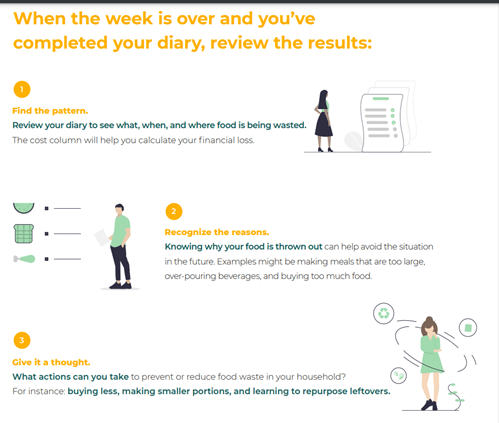
You can start by creating a weekly food waste diary. The FAO publication “Your Guide to Living Free of Waste” (2021) includes other useful tips for shopping smart at the store and tips to use at home as well. You can start by keeping a food waste prevention diary, via your phone, other electronic device, or the old fashion way – on paper.

Finally, see these 18 Food Waste Apps to Save Money & The Planet (2023):
and Vegan Zero Waste Recipes at:
https://www.almostzerowaste.com/recipes/
References
FAO, IFAD, UNICEF, WFP and WHO. The State of Food Security and Nutrition in the World 2023. Urbanization, agrifood systems transformation and healthy diets across the rural–urban continuum. Rome, Italy: FAO; 2023. doi.org/10.4060/cc3017en
UN. September 29, 2023. International Day of Awareness of Food Loss and Waste. Available at: http://wws.stopfoodlosswaste.org/
Stop Food Loss and Waste. For the People. For the Planet. Available at: https://www.fao.org/platform-food-loss-waste/flw-events/international-day-food-loss-and-waste/en
FAO, UNEP. September 29, 2023: International Day of Awareness of Food Loss and Waste. Available at: https://www.fao.org/3/cc7287en/cc7287en.pdf
The World Bank. Food Systems 2030. Available at: https://www.worldbank.org/en/programs/food-systems-2030/food-systems-transformation
FAO. 2021. Your Guide to Living Free of Food Waste. Budapest, Hungary. Available at: https://www.fao.org/publications/card/en/c/CB6601EN/
Vrachovaska M. 18 Awesome Food Waste Apps To Save Money & The Planet. 2023. Almost Zero Waste. Available at: https://www.almostzerowaste.com/apps-to-reduce-food-waste/
 Sustainable RDN